Teaching the Frankfurt School on the Culture Industry and Standardization of Cultural Products

In my sociological theory class recently, I was teaching about critical theory (i.e., “the Frankfurt School”). Specifically, students were reading excerpts from Theodor Adorno’s and Max Horkheimer’s work on “The Culture Industry,” excerpted from their 1944 book The Dialectic of Enlightenment.

Dialectic of EnlightenmentWe talked about how the production of mass cultural commodities (books, films, TV, music) is the same as all mass production. It is geared toward making a profit by minimizing the costs of production and maximizing consumption (i.e., “audience”). The result is homogeneity and predictability.

As Adorno and Horkheimer observed back in the 1940s, “As soon as the film begins, it is quite clear how it will end, and who will be rewarded punished or forgotten. In light music [popular music], once the trained ear heard the first note of the hit song, it can guess what is coming and feel flattered when it does come…The result is a constant reproduction of the same.”

In his essay “On Popular Music,” Adorno refers to the rules of standardization in popular music, the best know of which is that “the chorus consists of thirty two bars and that the range is limited to one octave and one note.” Mind-numbing.

To make this point, I usually just refer to Katy Perry and Jessie J. and whoever the latest pop star is, but this year one of my students pointed me to a song by the group, “Axis of Awesome” which makes this point much better than I could with my limited understanding of music. Check out the video for their song “4 Chords” below:

Enter to Win a Free Copy of My Book “Becoming Catholic” from Goodreads

.goodreadsGiveawayWidget { color: #555; font-family: georgia, serif; font-weight: normal; text-align: left; font-size: 14px;
font-style: normal; background: white; }
.goodreadsGiveawayWidget img { padding: 0 !important; margin: 0 !important; }
.goodreadsGiveawayWidget a { padding: 0 !important; margin: 0; color: #660; text-decoration: none; }
.goodreadsGiveawayWidget a:visted { color: #660; text-decoration: none; }
.goodreadsGiveawayWidget a:hover { color: #660; text-decoration: underline !important; }
.goodreadsGiveawayWidget p { margin: 0 0 .5em !important; padding: 0; }
.goodreadsGiveawayWidgetEnterLink { display: block; width: 150px; margin: 10px auto 0 !important; padding: 0px 5px !important;
text-align: center; line-height: 1.8em; color: #222; font-size: 14px; font-weight: bold;
border: 1px solid #6A6454; border-radius: 5px; font-family:arial,verdana,helvetica,sans-serif;
background-image:url(https://www.goodreads.com/images/layout/gr_button4.gif); background-repeat: repeat-x; background-color:#BBB596;
outline: 0; white-space: nowrap;
}
.goodreadsGiveawayWidgetEnterLink:hover { background-image:url(https://www.goodreads.com/images/layout/gr_button4_hover.gif);
color: black; text-decoration: none; cursor: pointer;
}

Goodreads Book Giveaway

Becoming Catholic by David Yamane

Becoming Catholic

by David Yamane

Giveaway ends April 30, 2014.

See the giveaway details
at Goodreads.

Enter to win

https://www.goodreads.com/giveaway/widget/89025

Jennifer Dawn Carlson on Gun Politics in America

As part of my ongoing effort to understand “Gun Culture 2.0,” I was fortunate recently to host a leading sociologist studying American gun culture, Jennifer Dawn Carlson.

Jennifer_Dawn_Carlson_Lecture_Flier_Feb_14

Dr. Carlson is an assistant professor at the University of Toronto, but despite working north of the border she is an American and primarily studies American society. She has published a number of newspaper opinion pieces which attempt to speak across the divide between “pro” and “anti” gun camps. Among these are: “The Gun Debate Misses the Mark in Detroit” in the Detroit News and “The NRA’s Hidden Power” in the Los Angeles Times.

Carlson’s presentation last month was based on ideas she is developing in a forthcoming book called Citizen-Protectors: The Everyday Politics of Guns in an Age of Decline (Oxford University Press, 2015). The book draws on research conducted on gun carriers — both open and concealed — in and around Detroit, Michigan, hence the “age of decline.” She argues that within the context of socioeconomic decline in general and personal decline experienced by men in particular, gun carriers reassert their relevance by identifying themselves as “citizen-protectors” (her term, not theirs).

In Carlson’s analysis, the social identity of the citizen-protector: (1) “Redefines lethal shooting, under certain circumstances, as a morally upstanding response to violent threat and an affirmation of one’s love for life,” (2) “Draws on the duty to protect as a historically male-dominated social function,” and (3) “Emphasizes protection as an esteemed form of masculinity.”

Thus, to understand why a growing number of Americans are getting licensed to carry handguns in public (or are exercising their right to open carry without a license where that is allowed) requires getting beyond the gun itself. Carrying a gun is about more than personal self-defense; it is an assertion of “relevance, dominance, and dignity.”

20140218_154411

One thing I find particularly valuable about Carlson’s work is her valiant effort both to understand where gun carriers are coming from and to explain this to those who come from outside the gun culture. Her ability to speak across the divide, I hope, is enhanced by the fact that she did all that she could (as a young female from the People’s Republic of Berkeley) to walk-the-walk with gun carriers. She got a Michigan concealed carry license and carried a firearm regularly, she became an NRA Certified Firearms Instructor, and she even open carried a handgun into a Detroit police station as part of a protest by open carriers. Short of actually shooting someone in defense of self or others, she did all she could to establish her bona fides.

Because I read it in draft form, I will not give away one of the punch lines to her book, but Carlson draws some important conclusions based on her time interviewing and hanging out with gun carriers. Conclusions she could only reach by hanging out with gun carriers. I am anxiously awaiting the publication of Citizen-Protectors to see whether those conclusions resonate with a broader audience.

Gun Digest Magazine Shows How NOT to Create a Pie Chart

Thumbing through the February 13, 2014 issue of Gun Digest magazine, I was excited to see data on a recent survey of first-time gun buyers, attributed to the National Shooting Sports Foundation (NSSF), the trade association for the shooting, hunting and firearms industry.

Two pie charts, shown below, describe (1) the percentage of new shooters who engage in certain activities (target shooting, hunting, plinking, etc.), and (2) how frequently new shooters shoot.

These are both very important pieces of information, but what’s wrong with this picture?

Gun Digest magazine, 13 February 2014, p. 11

If you answered that the pieces of the pie chart do not add up to a meaningful whole, you are correct. The first pie chart totals 264% and the second totals 80.3%. A meaningful whole in this case would be 100% of new shooters.

Pie charts are appropriate visual displays of information when we want to show the relative sizes or proportions of different phenomena as a part of a fixed whole. If one slice of the pie grows, another slice has to shrink. You can’t just expand the pie (to 264%). If you remove a slice of the pie, the other slices have to grow. You can’t just shrink the pie (to 80.3%).

A pie chart is not appropriate for a situation in which a single respondent can choose more than one category (a new shooter can be a target shooter and a hunter and a plinker, for example). Or when there are categories of responses that are not displayed (19.7% of new shooters shoot less than once a week or did not respond to this particular question, we can infer). In these cases, a bar chart is more appropriate to display the relative sizes of phenomena.

For a really excellent discussion of pie charts and their potential pitfalls, see “Understanding Pie Charts” on the eagereyes blog.

Reflections on My Reflections on Gun Culture Based on Site Statistics

Since November 2012, when I first started working in earnest on a new research project on American gun culture, I have tried to blog regularly at Gun Culture 2.0. I have been averaging about 5 posts a month since then, which is pretty good compared to my previous attempts at blogging (like on this blog).

As I noted in one of my first posts, “Jumping into the gun culture as a complete novice is like jumping into the deep end of the pool without knowing how to swim.” I wrote this after the movie theater attack in Aurora, Colorado that month. Things only got worse later in 2012 when the Sandy Hook massacre took place. What was already a challenge to get up to speed on only became worse.

As a consequence, my posts on Gun Culture 2.0 have ranged widely from my own experiences shooting to reviews of books about guns to my attempts to understand existing research on guns. I am pretty much all over the place.

I began the blog as a way to force myself to reflect in writing on gun culture – a way to force myself to write! – but not many people who take the time to write do it only for themselves. So of course I have been interested to know if anyone out in cyberspace is looking at my posts. Recently I decided to look at my site statistics to see how many people have visited and what they have been most interested in reading about.

Top Blog Posts

The majority of my posts have fewer than 100 views, so the 6,370 total page views since I started Gun Culture 2.0 are dominated by a few entries. The home page not surprisingly leads the way with 1,415 views (though June 14).

1. Massad Ayoob’s MAG-40 Course – A Humanitarian Approach to Armed Citizenship (735 views). This is a long entry, but for anyone interested in a very thoughtful approach to the rights and responsibilities of armed citizenship, Massad Ayoob is the man.

2. Understanding Case-Control Studies of Gun Ownership as a Risk Factor (656 views). I am glad so many people have looked at this, because a lot of the most often cited statistics on the dangers of keeping a gun in one’s home is based on case-control designs. I learned a lot myself about this methodology in writing this entry.

3. Massad Ayoob Checks the Accuracy of My Handgun (612 views). This entry is just funny, because you often hear people who shoot guns say things like, “That gun doesn’t shoot well.” Given my own experience, I wonder what percentage of the time the actual statement should be, “I don’t shoot well.” Guns don’t shoot badly; people shoot badly.

4. Assessing the Great Ammo Shortage of 2013 (592 views). The fact that this entry has gotten as many views as it has suggests how concerned people are about the ammo shortage.

5. Shooting the MAG-40 Qualification Course (545 views). Three of the top 5 most visited pages on my site have to do with Massad Ayoob and his MAG-40 course. Overall this suggests that people are a lot more interested in Massad Ayoob than they are in me!

6. Investigating the New York Times’ Dangerous Gun Myths (173 views). This entry is another long one, and probably too boring for mass consumption, but looking at specific claims made in a NYT editorial claiming to debunk gun myths is important for those who want to look below the surface of those claims.

7. The Culture of Fear and the Mass Murders of 2012 (114 views). Here is another entry I wish more people would read. Recently, a big to do was made about the near-simultaneous release of a government study that showed violent crimes committed with guns is way down over the past 20 years, and a Pew Research Center poll that shows that people perceive gun crime to be going up. But this is an old story — crime down, fear up – as I note in this entry from January 2013.

8. Thoughts on Banning Certain Types of Rifles and Magazines (107 views). Banning so-called “assault rifles” and so-called “high capacity” magazines is a panacea designed to make us feel better without making us significantly safer. Enough said, but I wish more people had looked at this page, too.

Visitors

From its inception, Gun Culture 2.0 has had 6,370 page views. I don’t have any basis for comparison in terms of blog readership, but I know this is more people than bought my first three books combined!

The best ever single day was 142 views. On that day I posted an entry on “Looking Forward to History’s Top Shot Season 5 All-Stars.” I like this because as I noted in my first ever entry, Top Shot had a major role in my interest in guns and gun culture.

My best month ever was May 2012 with 1,687 views. That was up from just over 1,000 in each of March and April. If I can get 1,000 page views a month, I am happy with that.

Although the vast majority (5,352 of 6,370) visits have been from the United States, I have also had 548 visitors from Australia, and the other 400+ visitors have come from 60 other countries including Vietnam, Slovenia, Kuwait, Nepal, South Africa, and Malta.

US News Rankings of Graduate Programs in Sociology

We’re number 1, we’re number 1!!!!! I got an email to this effect from the University of Wisconsin-Madison’s sociology department upon the release of the latest ranking of graduate programs by US News.

Of course I checked it out right away and was interested to see my undergraduate alma mater — UC-Berkeley — was also ranked #1. We’re #1 too, we’re #1 too. Actually, there was a 3 way tie with Princeton joining the two “Public Ivys” at the top with equal ratings of 4.7 out of 5.

I also can’t help but note that, despite the excessive emphasis on “high status” publications (American Sociological Review, American Journal of Sociology, and if you must go to the second tier then perhaps Social Forces) that forced me to leave back in 2004, the University of Notre Dame sociology department continues to languish in the 40s. I wonder if someone there is preparing an alternative ranking based on faculty publication rates as I type, as they have done in the past.

Although the pleading did make me uncomfortable while I was at Notre Dame, I can feel their pain since they are working so hard to be accepted in the upper echelons of the status hierarchy of the profession. (My intro soc students coincidentally read just this week an excerpt from Murray Milner’s Freaks, Geeks, and Cool Kids about status hiearchies among teenagers.)

To be sure, the methodology of the US News rankings is problematic. Key informants rating graduate programs on a scale of 1 to 5. I distinctly recall sitting in the office of one of the UW-Madison faculty who was sent the US News ranking form to complete. He was filling the form out as I sat there and kept saying, “I don’t know anyone there. I don’t know anyone there.” What place that is any good would not have people he knows!?
I guess in the end, even though it’s flawed, as long as it keeps UW-Madison on top, I’m good with it.


Ten Essential Observations on Guns in America by James D. Wright

In my introduction to sociology class this week, I am discussing sociologist James D. Wright’s classic essay, “Ten Essential Observations on Guns in America” (from Society March/April 1995, reprinted in Guns in America: A Reader).

Among his points: “There are 200 million guns already in circulation in the United States. . . . firearms are the most commonly owned piece of sporting equipment in the United States.” [Note: 270-300M today]

“Most of those 200 million guns are owned for socially innocuous sport and recreation purposes. . . . Gun ownership is … more appropriate to the sociology of leisure than to the criminology or epidemiology of violence.”

“Many guns are also owned for self-defense against crime, and some are indeed used for that purpose; whether they are actually any safer or not, many people certainly seem to feel safer when they have a gun.”

“Most of the gun violence problem results from the wrong kinds of people carrying guns at the wrong time and place.” Or as Canadian journalist Daniel Gardner says in The Science of Fear, “if you are not a drug dealer or the friend of a drug dealer, and you don’t hang out in places patronized by drug dealers and their friends, your chance of being murdered with a handgun shrinks almost to invisibility.” Or as Gun trainer John Farnham says: “Don’t go stupid places or do stupid things with stupid people.” This lowers your risk of homicide substantially, whether you have a gun or not.

“Everything the bad guys do with their guns is already against the law.” To wit: Sandy Hook shooter shot his mother (murder), illegally transported firearms into a gun free zone, etc. (some say he violated as many as 40 laws).

The first law of economics: “Demand creates its own supply.” Outlawing alcohol didn’t work, making certain drugs illegal hasn’t kept them out of the United States. If cocaine can make it from Colombia to Chicago, who thinks guns won’t make it from Brazil to Chicago?

“Guns are neither inherently good nor inherently evil; guns, that is, to not possess teleology.”

“Guns are important elements of our history and culture. . . .restrictions on the right to ‘keep and bear arms’ amount to the systematic destruction of a valued way of life and are thus a form of cultural genocide.”

Sociologists are Open Minded Toward the Open Minded

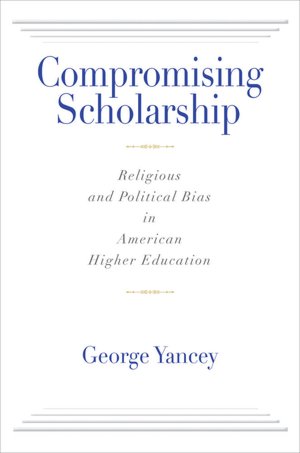
I just came across a review of some interesting work by my fellow sociologist of religion, George Yancey on religious and political bias in American higher education.

His book, Compromising Scholarship, was reviewed in a Chronicle of Higher Education Innovations blog post by Peter Wood called “Preferred Colleagues” (back in 2011 — I missed it!). Wood begins his review writing:

A new study presents evidence that more than a quarter of sociologists (27.8 percent) would “weigh favorably” membership in the Democratic Party by a candidate for academic appointment, and nearly 30 percent would weigh favorably a prospective candidate’s membership in the ACLU. More than a quarter (28.7 percent) would disfavor hiring a Republican, and 41.2 percent would weigh negatively a candidate’s membership in the National Rifle Association.

The study shows even greater bias against candidates with particular religious affiliations. Substantial numbers of the sociologists surveyed said they would be “less likely to hire” evangelical Christians and fundamentalists if they were aware that a candidate fell into either of those categories. Evangelicals face the barrier that 2 out of 5 sociologists (39.1 percent) are disposed not to hire them. Fundamentalists fare even a bit worse: 41.2 percent of sociologists say they would take such an affiliation negatively into account.

Imagine if you were to combine some of these categories of people — because, of course, we do not exist as separate variables in real life. Someone who is an Evangelical is more likely to be a Republican is more likely to be an NRA member. So, imagine asking sociologists to consider hiring a Evangelical, Republican, NRA member. Not going to happen.

I know in my own job interviews way back when someone at Notre Dame asked me if I was a “Catholic Restorationist” (whatever that is) and at another school I was asked to talk about what political magazines I read. Studying religion in general is suspicious to many sociologists, especially if there is some thought that the study has roots in some personal connection to religion.