Three Blog Posts on Initiation in the Contemporary Catholic Church

Oxford University Press was good enough to allow me to write three blog posts this Easter weekend with my thoughts on initiation in the contemporary Catholic Church. Here are links to the three posts:

  1. Initiation into America’s Original Megachurch (18 April 2014)
  2. Reinventing Rites of Passage in Contemporary America (19 April 2014)
  3. Easter Rites of Initiation Bring Good News for American Catholics (20 April 2014)

The posts build on my recently published study of the Rite of Christian Initiation of Adults, and hopefully build some interest in it.

You can order it from Barnes & Noble at a 20% discount, and also get it as a Nook book or for the Amazon Kindle (Amazon.com was recently sold out of the book, but hopefully it will come back in stock there, too.)
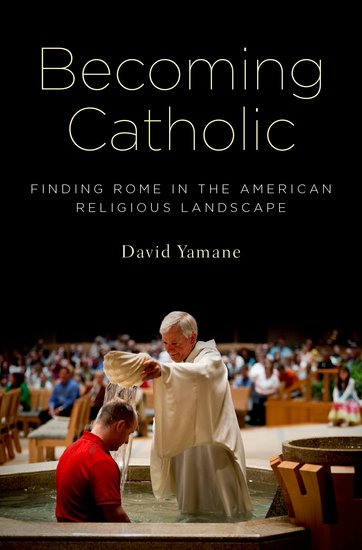
Becoming Catholic Cover

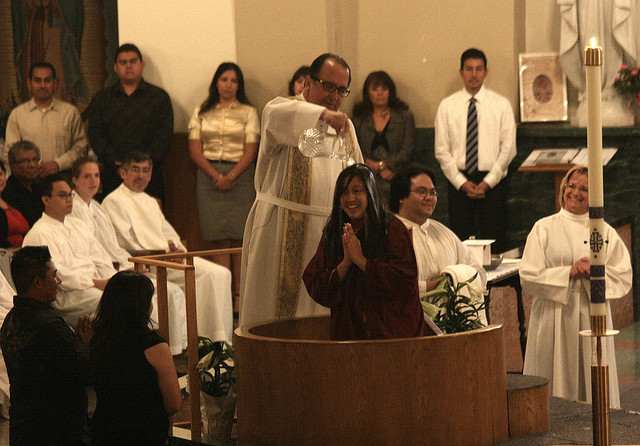
Photo of adult being baptized

– See more at: http://blog.oup.com/2014/04/easter-reflections-initiation-america-megachurch/#sthash.Le5Dj9ey.dpuf

Enter to Win a Free Copy of My Book “Becoming Catholic” from Goodreads

.goodreadsGiveawayWidget { color: #555; font-family: georgia, serif; font-weight: normal; text-align: left; font-size: 14px;
font-style: normal; background: white; }
.goodreadsGiveawayWidget img { padding: 0 !important; margin: 0 !important; }
.goodreadsGiveawayWidget a { padding: 0 !important; margin: 0; color: #660; text-decoration: none; }
.goodreadsGiveawayWidget a:visted { color: #660; text-decoration: none; }
.goodreadsGiveawayWidget a:hover { color: #660; text-decoration: underline !important; }
.goodreadsGiveawayWidget p { margin: 0 0 .5em !important; padding: 0; }
.goodreadsGiveawayWidgetEnterLink { display: block; width: 150px; margin: 10px auto 0 !important; padding: 0px 5px !important;
text-align: center; line-height: 1.8em; color: #222; font-size: 14px; font-weight: bold;
border: 1px solid #6A6454; border-radius: 5px; font-family:arial,verdana,helvetica,sans-serif;
background-image:url(https://www.goodreads.com/images/layout/gr_button4.gif); background-repeat: repeat-x; background-color:#BBB596;
outline: 0; white-space: nowrap;
}
.goodreadsGiveawayWidgetEnterLink:hover { background-image:url(https://www.goodreads.com/images/layout/gr_button4_hover.gif);
color: black; text-decoration: none; cursor: pointer;
}

Goodreads Book Giveaway

Becoming Catholic by David Yamane

Becoming Catholic

by David Yamane

Giveaway ends April 30, 2014.

See the giveaway details
at Goodreads.

Enter to win

https://www.goodreads.com/giveaway/widget/89025

Sociologists are Open Minded Toward the Open Minded

I just came across a review of some interesting work by my fellow sociologist of religion, George Yancey on religious and political bias in American higher education.

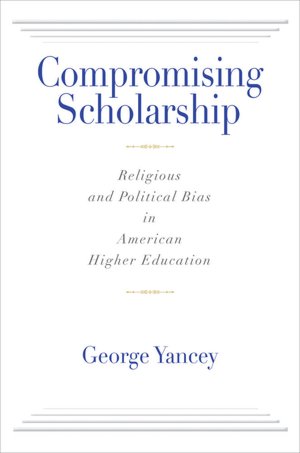
His book, Compromising Scholarship, was reviewed in a Chronicle of Higher Education Innovations blog post by Peter Wood called “Preferred Colleagues” (back in 2011 — I missed it!). Wood begins his review writing:

A new study presents evidence that more than a quarter of sociologists (27.8 percent) would “weigh favorably” membership in the Democratic Party by a candidate for academic appointment, and nearly 30 percent would weigh favorably a prospective candidate’s membership in the ACLU. More than a quarter (28.7 percent) would disfavor hiring a Republican, and 41.2 percent would weigh negatively a candidate’s membership in the National Rifle Association.

The study shows even greater bias against candidates with particular religious affiliations. Substantial numbers of the sociologists surveyed said they would be “less likely to hire” evangelical Christians and fundamentalists if they were aware that a candidate fell into either of those categories. Evangelicals face the barrier that 2 out of 5 sociologists (39.1 percent) are disposed not to hire them. Fundamentalists fare even a bit worse: 41.2 percent of sociologists say they would take such an affiliation negatively into account.

Imagine if you were to combine some of these categories of people — because, of course, we do not exist as separate variables in real life. Someone who is an Evangelical is more likely to be a Republican is more likely to be an NRA member. So, imagine asking sociologists to consider hiring a Evangelical, Republican, NRA member. Not going to happen.

I know in my own job interviews way back when someone at Notre Dame asked me if I was a “Catholic Restorationist” (whatever that is) and at another school I was asked to talk about what political magazines I read. Studying religion in general is suspicious to many sociologists, especially if there is some thought that the study has roots in some personal connection to religion.

Shopping for Faith in the American Spiritual Marketplace

Much has been made in recent years about the phenomenon of American religion as a “spiritual marketplace” in which individuals are consumers out “shopping for faith” that suits their religious or spiritual tastes. But how do we reconcile this image of a large and diverse marketplace of producers and consumers with the considerable conventionality we also see in American religion? Sure we have Scientologists, Wiccans, UFO cultists, Zen Buddhists, and other religions from outside the dominant Judeo-Christian tradition, but they are a tiny fraction of the market, especially compared to conventional faiths like Roman Catholicism and the major brands of Protestant Christianity. So, how do the spiritual marketplace and religious conventionality relate to one another? They are like cornflakes and milk.

When I think about how consumers behave in the marketplace generally, this is not at all surprising. When I offer to take students out for a meal, I usually allow them to pick the restaurant. What do they choose? TGIFridays, Outback Steakhouse, Olive Garden, Texas Roadhouse, Panera. Chain, chain, chain, chain, chain. Standardization. Standardization. Standardization. Conventionality.

The American marketplace provides us with all sort of interesting, quirky choices in terms of products, stores, and restaurants. And yet everyone wants to buy Dockers, shop at Wal-Mart, and eat a Applebee’s. Why? Not only is shopping costly in terms of time and energy, but buying something that we are unfamiliar with is very risky.

So, it’s not at all surprising that when Americans “shop for faith” they often end up buying at the most well-established stores.

Speaking of Duke

Speaking of Duke, here’s a quote from a recent New York Times article called “Rebels with a Cross”:

[Christian Smith, a University of North Carolina sociologist,] compared the romance of rebellion to the middle-class fascination with hip-hop culture. “Spoiled suburban white kids act like rappers, and there is a real connection to something, but really it’s not what their lives are fundamentally about,” he said. “Their lives are about wanting to go to Duke University.”