My Love of Whisk(e)y and the Alcohol Epidemic in the United States

I love whisk(e)y. My love knows almost no boundaries. American, Canadian, Indian, Irish, Japanese, Scotch, Texas. Barley, corn, rye, wheat. Neat, rocks, mixed.

To fuel my love I have been reading Reid Mitenbuler’s recent book, Bourbon Empire: The Past and Future of America’s Whiskey.

cover-image-bourbon-empireEarly on, Mitenbuler introduces the first alcohol distiller among the British colonists, George Thorpe. Around 1620, Thorpe first distilled alcohol from Indian corn mash in the Berkeley settlement near Jamestown, Virginia. (See another account of this here.)

This wasn’t because without the distilled spirit the colonists would be tee-totalers. Nay. Mitenbuler makes clear that the colonists loaded their ships with beer for their trips across the Atlantic and to sustain them in the colonies.

Alcohol, then as now, was part and parcel of the everyday lives of people living on this continent.

Although I am still in the revolutionary era in the book, I expect that Mitenbuler will discuss the many personal and social ills associated with alcohol use. These, of course, led up to the historic and failed experiment with banning alcohol from 1920 (with the ratification of the 18th Amendment to the U.S. Constitution) to 1933 (with the ratification of the 21st Amendment).

Since the repeal of prohibition, public health scholars continue to document the toll that alcohol takes on individual lives and our society as a whole. According to the Centers for Disease Control, among the short-term health risks of inappropriate alcohol use are:

  • Injuries, such as motor vehicle crashes, falls, drownings, and burns.
  • Violence, including homicide, suicide, sexual assault, and intimate partner violence.
  • Alcohol poisoning, a medical emergency that results from high blood alcohol levels.
  • Risky sexual behaviors, including unprotected sex or sex with multiple partners. These behaviors can result in unintended pregnancy or sexually transmitted diseases, including HIV.
  • Miscarriage and stillbirth or fetal alcohol spectrum disorders (FASDs) among pregnant women.

Long-term health risks include:

  • High blood pressure, heart disease, stroke, liver disease, and digestive problems.
  • Cancer of the breast, mouth, throat, esophagus, liver, and colon.
  • Learning and memory problems, including dementia and poor school performance.
  • Mental health problems, including depression and anxiety.
  • Social problems, including lost productivity, family problems, and unemployment.
  • Alcohol dependence, or alcoholism.

Despite this epidemic of alcohol-related problems in America, any person over 21 years of age can walk into most supermarkets, liquor stores, wine stores, beer stores, bars, or restaurants and buy alcohol. No “prohibited persons,” no permit required, no criminal background check, no mental health assessment, no registration, no additional fee beyond the cost of the product.

To see how easy it is to find alcohol in my quasi-homeland, I asked Google how many liquor stores there are in San Francisco.* Google returned the following map:

liquor stores in san franciscoIt is surprising that given the daily toll taken on individuals and our society as a whole that more people are not up in arms about this alcohol epidemic.

Of course, what could the people possibly do to resist the virtual ownership of the federal government by the alcohol lobby, which according to the Center for Responsive Politics’ opensecrets.org website had 292 lobbyists, $18.9 million in expenditures, and 31 clients in 2015.**

Thankfully, no one holds me — a responsible alcohol user — accountable for the mis-use of alcohol by (many, many thousands of) others. No one looks to me to be part of the solution rather than part of the problem. No one requires me to have a 0.00 blood alcohol content before driving because so many others drink and drive irresponsibly. No one asks me how many more people have to die before I, for the good of my fellow citizens, give up alcohol. (Because if we could prevent even one more death by instituting common sense alcohol laws…)

The problems associated with alcohol in this country also do not prevent me, thanks be to God, from being able to purchase and consume the product.

20151209_215426.jpgI am also extremely fortunate to have very generous friends who share my love of whisk(e)y with me. To wit: Last night my friend offered a bourbon and rye tasting competition between Tennessee-based Prichard’s Distillery and the Buffalo Trace-owned Colonel E.H. Taylor brand.

The clear winner was Prichard’s Double Barreled bourbon, so named because the spirit is aged once at 120 proof in new charred oak barrels (as is required by law to be called a bourbon), then cut to 95 proof and re-aged in new charred oak barrels. The double barreled aging and the relatively moderate alcohol content (in comparison to many craft bourbons today), 90 proof in the bottle, made this an easy-drinking bourbon. And somehow, despite being aged twice in new charred barrels, it was not overly sweet.

The name and label art was also a big winner, in my opinion at least, because I also love a double barreled shotgun.

20151209_215435.jpg*San Francisco, the land of unicorns and rainbows, where the last gun store, High Bridge Arms, was just forced out of business.

**Compared to 55 lobbyists, $8.4M, and 8 clients for the gun rights lobby in 2015.
Post-Paris Reflection: We are PROBABLY Safe, but Not CERTAINLY Safe

Following the picture below is some text that was originally posted on my Gun Culture 2.0 blog last Saturday. I thought to re-post it here today because I am leaving for Washington, DC in a couple of hours and have been thinking about the advisability of the trip in light of the Paris attacks.

On the one hand, part of me thinks that I am not in any more danger now than before. I am just more realistically aware of the possibility of a terrorist attack than I was a week ago

On the other hand, part of me wonders whether we are entering a new, escalated phase of terrorism, in which case I am in more danger now than before. Especially traveling to a city which has to be higher on terrorists’ hit lists than a mid-sized city in North Carolina.

In any event, I am going and hope to avoid all of the dangers I will face over the next 5 days — probable and improbable alike.

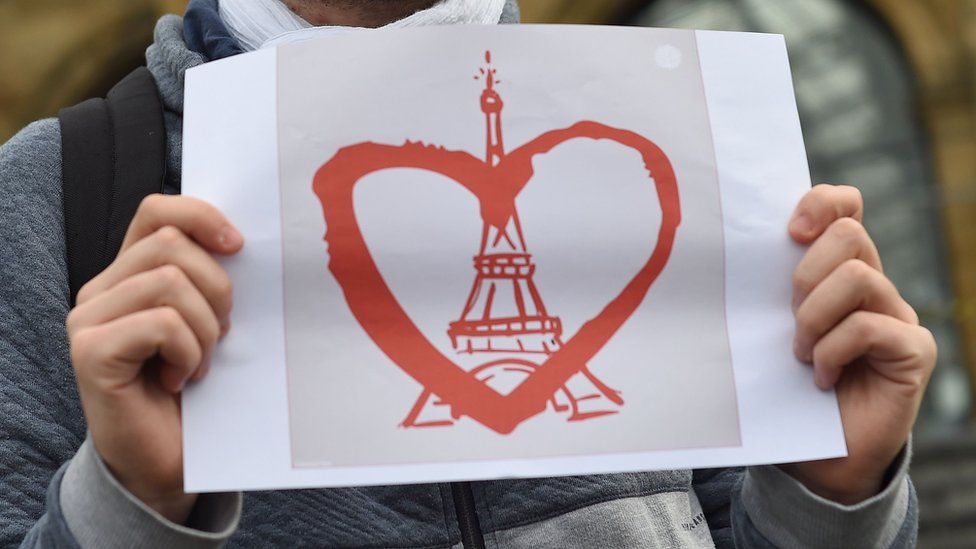
_86686544_afp_heartIt is disgusting but not shocking to hear about terrorist attacks in Paris last night.

This morning I received an email from my university’s office of communications and external relations reassuring our community that university officials “have not heard of any student who has been harmed or is in danger . . . All are safe.” Furthermore, there is no indication that any faculty or staff member “has been harmed or is in danger, either, in France.”

Although it was good to know that no member of our university community had been harmed, I was surprised to read that the university also believed that none were “in danger” and that they “are safe.”

The very fact of the terrorist attack that created the need for the communication suggests that no one in Paris, no one in France, no one anywhere is safe and out of danger.

At the same time, as people ratchet up concern on social media and the 24 hour news cycle kicks into high gear, I remind myself of the work of Steven Pinker showing that we live in the most peaceable time in human history.

So, we are probably safe, but not certainly safe.

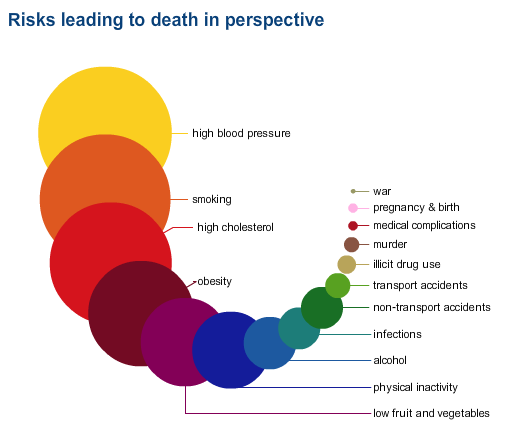
I think about Pinker also as I prepare to travel to Washington, DC for a conference this coming week. Washington, DC seems like it would be a major target for terrorist activity, and yet I try to remind myself that I am more likely to die in a car crash driving to DC than I am to be a victim of a terrorist attack. I’m more likely to die from the saturated fats I will consume while I am there. More likely to die from the work-related stress of preparing for my presentation. More likely to die from the exercise I won’t get because of the conference. Even more likely to die from being attacked in a city with a high rate of violent crime and limited civilian access to the means of lethal force for purposes of self-defense.

risks.0The infographic above is for the UK, but the risk factors for death are very similar in the United States. In the end, I’m afraid that in so many ways we are our own worst enemies.

I Am a Professor

There, I said it. I am a professor. The description does not exactly roll off my tongue. I am a professor. It somehow sounds pompous to me. So I generally avoid saying it.

T-shirt suggested for me on my Facebook feed

When I am traveling and a cab driver asks me what I do for a living, or at holiday parties when I am making small talk with people I have just met, I usually say “I teach at Wake Forest.” Which is true enough, as far as it goes. But it doesn’t go very far.

I spend 40% or less of my work time teaching (in and out of class), preparing to teach, or grading. In fact, the 300-375 minutes/week I spend in classrooms (30 weeks a year, not counting summer teaching) is one of the smallest parts of my job.

I spend another 10-20% of my time in department, college, university, and professional service activities (committee work, doing peer reviews).

So the majority of my time I spend reading, researching, and writing for publication. And this, I think, is what most distinguishes being a “professor” from being a “teacher.”

But I don’t think many people get the distinction. Even though a large and growing percentage of the American population today has graduated from college, the majority of college graduates have little contact with professors outside of class. So all they know about the job is that professors teach.

Posted in a dorm common area at Western Carolina University

And at many colleges and universities, there is no expectation that faculty will do anything other than teaching (and doing institutional service work). In these cases, saying one is a “teacher” is perfectly descriptive of the job, even if the formal job title is “professor.” (This also applies to institutions where faculty are suppose to do more than teach, but do not.)

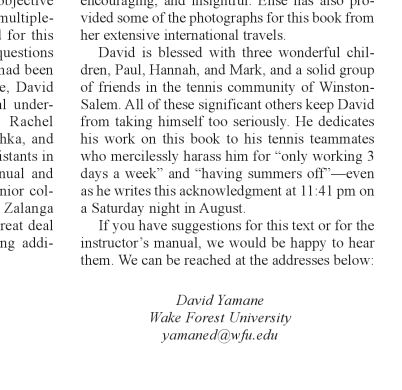
Still, I get frustrated sometimes when people say “must be nice to have summers off” or “must be nice to work only 3 days a week.” Depending on my mood, this is true even when I know they are joking, as with the guys I play tennis with. I came across the dedication below (for my sociology of religion textbook) recently because I have been working on the revisions for the new edition of the book over this winter “break.” It expresses my frustration.

My acknowledgements for the 5th edition of my religion textbook with Keith Roberts

In fact, I have been working on the textbook revisions for 10-12 hours a day 6 days a week from the moment I turned in my fall grades. And I will be working on it until the moment I step into class for the spring semester. So when people ask me how my winter break is going, I want to channel John McEnroe and scream, “You cannot be serious!” Or at least to say, “Must be nice to have some time off for the holidays. I wouldn’t know.”

But when I settle down and upon reflection I realize that I am part of the problem. I perpetuate it by continuing to say “I teach at Wake Forest” rather than saying “I am a professor” when people ask me what I do for a living.

It still doesn’t roll easily off my tongue, but at least it better reflects who I actually am and what I actually do. I am a professor, dammit.

Concluding note: My lovely wife, who is an occupational health nurse working in manufacturing facilities, will read this post and think, “Quit complaining. You don’t have a real job. The people I work with have real jobs.” To her I say: I would not trade my job for any other. I love my job. It is a great job. But it is a job. A more than full-time job, where you work six days a week, not three, and where you don’t have summers or winters off. That is all. Now I have to get back to my textbook revisions.

Oral Arguments in the Supreme Court

On my Gun Culture 2.0 blog recently I wrote about attending a talk by an attorney who had argued recently before the Supreme Court of the United States (SCOTUS).

Richard-Dietz-Abramski-large

One of the most interesting things I have done in my time in Washington, DC is to go see oral arguments in the SCOTUS. Back in 1988, when we were just kids, my friend Boaz Roth and I put on some nice clothes and got in line early to see the court in action. We nonetheless seemed to be on the border of getting in. As we inched our way forward, it was hard to tell where the cut off would be. Then the guard pointed to us and said “the two gentlemen in the suits,” and we were the last two admitted. I’m sure it was the suits.

The basic structure is that each side has 30 minutes to present their case, beginning with the plaintiff. The plaintiff has the option of reserving 5 minutes after the defense for rebuttal.

The real excitement begins as soon as each attorney faces the 9 Supreme Court Justices, and says, “Mr. Chief Justice, and may it please the court. . . ” From that point forward, at any time, any of the justices can interrupt the attorney’s presentation to ask questions. So the attorney has to try to make an argument in the midst of responding to questions — some helpful, some hostile — from 9 judges. (Or, in recent court precedings, 8 because Justice Clarence Thomas rarely asks questions.)

This can be seen in the case I wrote about, Abramski v. United States.The transcript of the oral arguments in this case can be examined here. You can also listen to an audio recording of the arguments that tracks the transcript here.

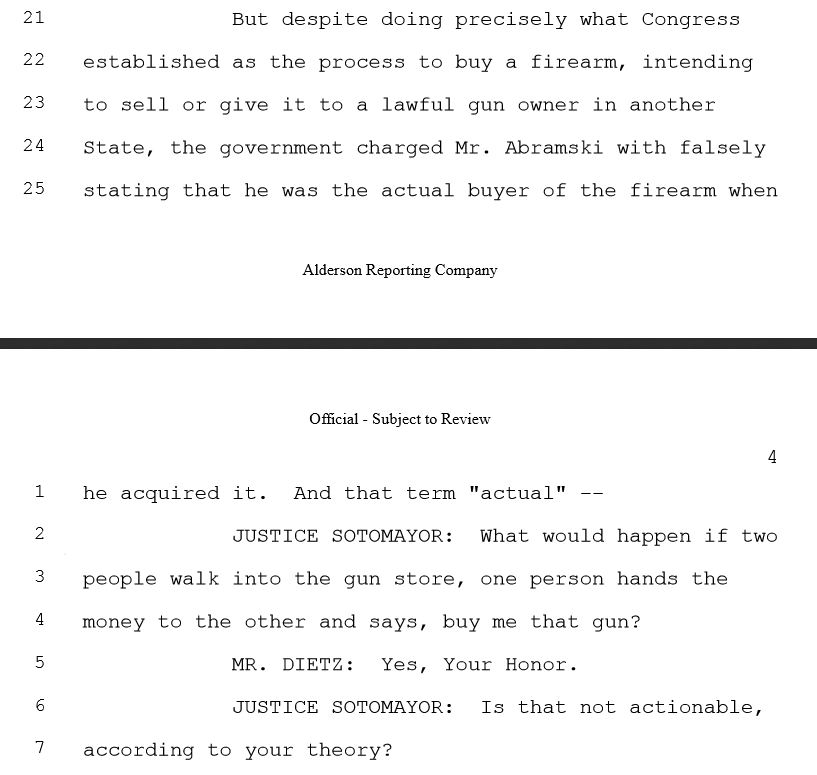
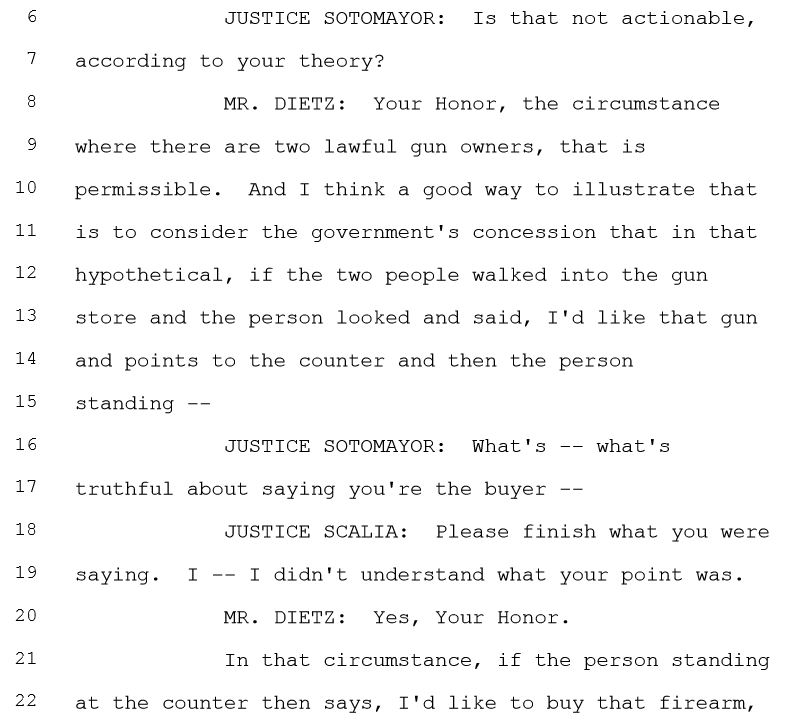
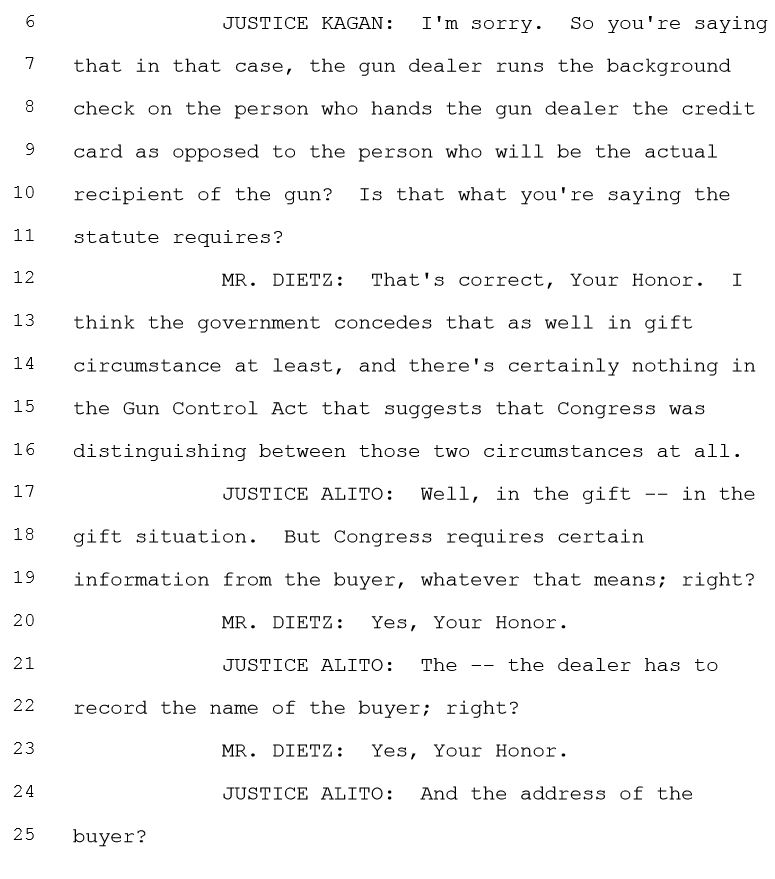
Attorney Richard Dietz, representing Abramski, was beginning his 6th sentence, 50 seconds into his opening, simply reviewing the facts of the case, when Justice Sonia Sotomayor jumped in to ask him a question. Abramski Transcript 1As Dietz was trying to answer the question, Sotomayor pressed her questioning, but then an interesting thing happened. A more sympathetic justice, Antonin Scalia, came to Dietz’s aid. Abramski Transcript 2

Dietz continued following Scalia’s save, only to draw more fire from Justice Elena Kagan and the immediately after, Justice Samuel Alito. Abramski Transcript 3And so on for 25 minutes. Despite getting 25 minutes to present his case, reserving 5 minutes for rebuttal, Dietz actually shared his time with 8 justices (all but Clarence Thomas). So, he has to continue to try to make his case while at the same time responding to persistent questioning from the justices.

A great challenge and why it is a rare honor and ability to argue cases before the Supreme Court. And why it should be a bucket list item for American citizens.

CONCLUDING ASIDE: In the talk I attended the speaker gave some interesting facts about decisions handed down in the last term (2013). Of approximately 70 cases, almost 40% were unanimous decisions by the 9 justices. Just under 30% were “split” decisions — either 6-3 or 5-4. This suggests that most of the cases decided by SCOTUS are not driven by an ideological “liberal” vs. “conservative” divide.