Teaching the Frankfurt School on the Culture Industry and Standardization of Cultural Products

In my sociological theory class recently, I was teaching about critical theory (i.e., “the Frankfurt School”). Specifically, students were reading excerpts from Theodor Adorno’s and Max Horkheimer’s work on “The Culture Industry,” excerpted from their 1944 book The Dialectic of Enlightenment.

Dialectic of EnlightenmentWe talked about how the production of mass cultural commodities (books, films, TV, music) is the same as all mass production. It is geared toward making a profit by minimizing the costs of production and maximizing consumption (i.e., “audience”). The result is homogeneity and predictability.

As Adorno and Horkheimer observed back in the 1940s, “As soon as the film begins, it is quite clear how it will end, and who will be rewarded punished or forgotten. In light music [popular music], once the trained ear heard the first note of the hit song, it can guess what is coming and feel flattered when it does come…The result is a constant reproduction of the same.”

In his essay “On Popular Music,” Adorno refers to the rules of standardization in popular music, the best know of which is that “the chorus consists of thirty two bars and that the range is limited to one octave and one note.” Mind-numbing.

To make this point, I usually just refer to Katy Perry and Jessie J. and whoever the latest pop star is, but this year one of my students pointed me to a song by the group, “Axis of Awesome” which makes this point much better than I could with my limited understanding of music. Check out the video for their song “4 Chords” below:

US News Rankings of Graduate Programs in Sociology

We’re number 1, we’re number 1!!!!! I got an email to this effect from the University of Wisconsin-Madison’s sociology department upon the release of the latest ranking of graduate programs by US News.

Of course I checked it out right away and was interested to see my undergraduate alma mater — UC-Berkeley — was also ranked #1. We’re #1 too, we’re #1 too. Actually, there was a 3 way tie with Princeton joining the two “Public Ivys” at the top with equal ratings of 4.7 out of 5.

I also can’t help but note that, despite the excessive emphasis on “high status” publications (American Sociological Review, American Journal of Sociology, and if you must go to the second tier then perhaps Social Forces) that forced me to leave back in 2004, the University of Notre Dame sociology department continues to languish in the 40s. I wonder if someone there is preparing an alternative ranking based on faculty publication rates as I type, as they have done in the past.

Although the pleading did make me uncomfortable while I was at Notre Dame, I can feel their pain since they are working so hard to be accepted in the upper echelons of the status hierarchy of the profession. (My intro soc students coincidentally read just this week an excerpt from Murray Milner’s Freaks, Geeks, and Cool Kids about status hiearchies among teenagers.)

To be sure, the methodology of the US News rankings is problematic. Key informants rating graduate programs on a scale of 1 to 5. I distinctly recall sitting in the office of one of the UW-Madison faculty who was sent the US News ranking form to complete. He was filling the form out as I sat there and kept saying, “I don’t know anyone there. I don’t know anyone there.” What place that is any good would not have people he knows!?
I guess in the end, even though it’s flawed, as long as it keeps UW-Madison on top, I’m good with it.


Sociologists are Open Minded Toward the Open Minded

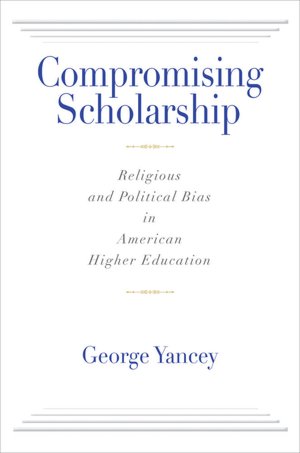
I just came across a review of some interesting work by my fellow sociologist of religion, George Yancey on religious and political bias in American higher education.

His book, Compromising Scholarship, was reviewed in a Chronicle of Higher Education Innovations blog post by Peter Wood called “Preferred Colleagues” (back in 2011 — I missed it!). Wood begins his review writing:

A new study presents evidence that more than a quarter of sociologists (27.8 percent) would “weigh favorably” membership in the Democratic Party by a candidate for academic appointment, and nearly 30 percent would weigh favorably a prospective candidate’s membership in the ACLU. More than a quarter (28.7 percent) would disfavor hiring a Republican, and 41.2 percent would weigh negatively a candidate’s membership in the National Rifle Association.

The study shows even greater bias against candidates with particular religious affiliations. Substantial numbers of the sociologists surveyed said they would be “less likely to hire” evangelical Christians and fundamentalists if they were aware that a candidate fell into either of those categories. Evangelicals face the barrier that 2 out of 5 sociologists (39.1 percent) are disposed not to hire them. Fundamentalists fare even a bit worse: 41.2 percent of sociologists say they would take such an affiliation negatively into account.

Imagine if you were to combine some of these categories of people — because, of course, we do not exist as separate variables in real life. Someone who is an Evangelical is more likely to be a Republican is more likely to be an NRA member. So, imagine asking sociologists to consider hiring a Evangelical, Republican, NRA member. Not going to happen.

I know in my own job interviews way back when someone at Notre Dame asked me if I was a “Catholic Restorationist” (whatever that is) and at another school I was asked to talk about what political magazines I read. Studying religion in general is suspicious to many sociologists, especially if there is some thought that the study has roots in some personal connection to religion.

Title IX at Wake Forest University

I find Title IX endlessly complex and fascinating. I am teaching the Sociology of Sport this fall and the more I dig into the issue, the less I feel like I know and the more I want to know. In response to a class discussion, a student forwarded me the following email from our university president. I know I got this email also, but can’t find it.

———- Forwarded message ———-
From: Nathan O. Hatch <>
Date: Fri, Feb 24, 2012 at 1:16 PM
Subject: Action required on Title IX training
To: broadcast-all@xxxxxx

Dear Students, Faculty and Staff:
On April 4, 2011, the Department of Education’s Office of Civil Rights issued a “Dear Colleague” Letter (DCL) addressing issues of sexual violence and misconduct on college campuses. The DCL gave colleges and universities guidance on how they should address these issues on their campuses. One of the DCL recommendations is that schools implement preventive education programs regarding sexual violence and misconduct, including information about available resources and the school’s policies and procedures for responding to complaints. We have created a website that includes educational materials for faculty, staff and students that can be found at http://go.wfu.edu/sexualassault.
The Wake Forest Sexual Misconduct Policy includes information about how to report incidents of sexual misconduct, resources available to students and information about sexual misconduct hearings that occur on campus. We take these matters very seriously, and there are a number of programs and resources in place to support our entire campus community.
We have also recently named a new Title IX Coordinator, Angela Culler, Assistant Vice President for Employee Relations and Compliance, who is available to speak to victims of sexual misconduct. There are also several Title IX Deputy Coordinators available to assist in these matters, including Charlene Buckley (Office of Dean of Student Services), Betsy Hoppe (Schools of Business), Barbara Walker (Athletics), Shonda Jones (Divinity School), Ann Gibbs (Law School), Brad Jones (Graduate School of Arts and Sciences) and Doris McLaughlin (Human Resources).
Wake Forest believes in the importance of making all employees and students aware of this information and the University’s Sexual Misconduct Policy. We ask that you make time in the next two weeks to visit the following website, review the information and complete a short test to certify that you have read and understood this important information.

Please provide your Wake Forest network username and password when prompted. (For assistance with your user name and password, please visit the Information Systems Service Desk located at The Bridge in the Z Smith Reynolds Library.) Every employee and student must complete this training as promptly as possible, and no later than March 9, 2012.

Wake Forest University is firmly committed to providing all individuals with an environment that is free of sexual harassment and sexual violence. Thank you so much for your assistance in achieving this important goal.
Sincerely,
Nathan O. Hatch
President

Evidence Shows The Fraternity Experience is The Problem

Posted by John D. Foubert, Ph.D. , Author, The Men’s and Women’s Programs at Ending Rape Through Peer Education on April 29, 2011 at 7:15am EDT

In 2007 I published a study of men who join fraternities, comparing their rates of sexual assault before they join and after they join. Before they join, their rates were statistically equal. After they join, men in fraternities commit much more sexual assault. This provides, at a minimum, preliminary evidence that the fraternity experience and culture that helps contribute to rape (Foubert, Newberry & Tatum, 2007). Furthermore, two different longitudinal studies have shown men in fraternities to be three times more likely to rape than other men on college campuses (Foubert, Newberry, & Tatum, 2007; Loh, Gidycz, Lobo, & Luthra, 2005). That is startling.

It is time for the national fraternity community to take responsibility for this data by doing something about their culture and the actions of their members on a broad scale, not just taking action against a chapter or two when an incident gets media attention. Not since the 1990s have I seen a shred of responsibility taken by a national fraternity organization for this problem. I have presented my research, cited above, repeatedly at national fraternity conventions and not a single organization in the national fraternity community has stepped forward to make a serious commitment to do anything to take responsibility for ending sexual assault using a research based rape prevention approach. Occasional lip service? Perhaps. It is time for a serious commitment, real change, and if it means that some national fraternities need to go bankrupt through litigation in the process through Title IX lawsuits, so be it. Wake up.

Drinking in Exam Week Hurts College Students’ Performance

Stop the presses! This shocking news from “Inside Higher Education”:

Drinking in Exam Week Hurts College Students’ Performance

College students who drink before and during their final exams show a “statistically and economically meaningful reduction in academic performance” — “of approximately the same magnitude as being assigned to a professor whose quality is one standard deviation below average,” say the authors of a new study released by the National Bureau of Economic Research. The study, by economists at the University of California at Davis, the University of Pittsburgh, and the U.S. Air Force Academy, take advantage of the Air Force Academy’s vigorous enforcement of the drinking age to compare the performance on exams of students who turn 21 before the exam period begins with the performance of those under 21, to “distinguish the effects of drinking from confounding factors.” The lowering of performance they discover is “largely driven by the highest-performing students,” the authors write.

Reflections on 5 Days in the Life of a Tenured Professor

I have to admit I was shocked to total up my working hours last week and see that I only worked 42.5 hours. I’ve been thinking alot about why it seems like I worked much more than that. Here are some conclusions I’ve come to:

(1) I have read somewhere (I can’t remember where!) that the average employee works (actually works!) only 26 hours per week.

(2) The lack of control over my time makes many of those 42.5 hours seem alot worse than they are.

(3) Other responsibilities outside of my main job leave little room for rest.

(4) The knowledge that even 40 hours is not enough to get everything done is a stressor. Hence, I put in another 7 hours today (Sunday) sending faculty in the department information about their upcoming salary review, scheduling meetings with journal interns, and drafting a memo to the dean requesting permission to hire this year and next.

The life of a tenured professor is a great one, and I don’t at all want to come off as complaining. But it is not as though tenure has made us all into a bunch of slackers. To the contrary, most (but certainly not all) of us tenured professors continue to work as hard as ever — because we like what we do.

Day in the Life, Day 5

Day 5: Friday. Busy morning and relaxing afternoon ahead.

6:15am: Wake up, shower, dress, coffee, kids to bus

7:30am: In my office, chatting with colleague on phone

8:00am: Check email and prepare for 8:30am meeting and 9:30am phone call.

8:30am: Meeting regarding personnel issue

9:30am: Phone conversation with woman from England working on on-line submission system for journal

10:15am: Meeting with undergrad student working as teaching assistant for me

10:45am: Touch base with department admins, sign forms, etc.; talk to faculty member leading our hiring process; final check of emails

11:45am: Leave campus for indoor center to drop off rackets for tennis team and play tennis(!!!)

2:00pm: Lunch, post office, bank

3:00pm-4:45pm: Watch women’s tennis match

4:45pm: Get son from basketball practice

5:30pm: Home, go through mail

6:00-7:30pm: Nap

7:30pm: Dinner

8:00pm-10:30pm: String tennis rackets

10:30pm-Midnight: Check email, correspond about departmental affairs, schedule meetings for next week

Midnight-12:30pm: Draft memo to dean about department’s hiring needs for next year, while checking eBay, facebook, blog.

12:30pm: Tequila and bed

Total hours worked: c.6

Day in the Life, Day 4

Day 4: Wake up late from staying up too late last night. Day full of teaching and meetings ahead.

8:00am: Wake up, coffee, shower, dress, take out recycling. Everyone already gone to school and work.

9:00am: Decide to work at home until 11:00am meeting. Check email, prepare for class today.

11:00am: Arrive at office at last.

11:00am: Meet with honors student to discuss research interviews, and departmental admins to discuss departmental matters

12:00pm-1:15pm: Class

1:30pm: Lunch (non-working for a change!)

2:30pm: Office hours: meet two students regarding courses

3:00pm-4:15pm: Meeting with interns to train on on-line submission system for journal, and follow-up email queries to system designer

4:15pm: Go to tennis center to pick up rackets; compose and send emails that have to go out today.

5:15pm: Get son from school basketball practice

6:00pm: Deliver son to church league basketball practice

6:00pm-7:30pm: Work on faculty salary review materials during practice

7:45pm-9:00pm: Home, dinner, kids to bed, talk to wife about daughter’s courses for next year

9:00pm-11:00pm: String and grip tennis rackets

11:00pm-11:30pm: Revise and post class assignment to course website; email students

11:30pm-12:00pm: Check eBay, facebook, blog.

12:30pm: Bourbon and bed

Total hours worked: c.9