Mencken and Froese on the Sources and Strength of America’s Gun Culture

As I noted in my last post, scholars associated with the 2014 Baylor Religion Survey held a session at the recent annual meeting of the Society for the Scientific Study of Religion unveiling their data. (Of course, this is more of a tease since the data will not be publicly available for a year or two.)

Although there were four presentations, the one by Paul Froese and Carson Mencken on gun culture garnered the most interest – including mine!

Professor F. Carson Mencken (left) courtesy of Baylor University Media Communications
Photo of Professor F. Carson Mencken (left) courtesy of Baylor University Media Communications
Photo of Paul Froese courtesy of Baylor University Media Communications

Froese and Mencken noted, rightfully so, that accessing the symbolic and affective nature of the gun itself for gun owners is something that is done well in qualitative studies (by Kohn, Taylor, Floyd, Burbick, and Carlson, as noted in my previous post), but not in studies based on nationally-representative samples.

The authors of the Baylor Religion Survey hoped to bridge this gap by posing the following question:

Q72. If you own a gun, please indicate how strongly you agree or disagree with the following statement: Owning a gun makes me feel: (a) Safe. (b) Responsible. (c) Confident. (d) Patriotic. (e) In control of my fate. (f) More valuable to my family. (g) More valuable to my community. (h) Respected.

Response categories for each subpart were: strongly agree, agree, neutral, disagree, and strongly disagree. The authors see the first four Likert items (“a” through “d”) as measuring a dimension of power and the second four (“e” through “h”) as measuring a dimension of morality. Taken together, responses to these questions constitute a Likert scale of intensity of attachment to guns. The authors reported a scale reliability statistic of alpha = 0.86, which is very good for social scientific scales.

Using multivariate statistical modeling, the authors attempted to identify the factors associated with higher levels of attachment to guns. Using a question on the survey about economic despair, Froese and Mencken find that higher levels of economic despair are related to higher levels of attachment to guns. This finding, however, holds only among white gun owners. They surmise that black gun owners may be more accustomed to economic deprivation given America’s history of racial inequality, and so they are less likely to exhibit the “substitution effect” of replacing economic empowerment with empowerment through guns.

This confirms in a nationally-representative sample of respondents what Jennifer Dawn Carlson found in her ethnographic study of gun carriers in Detroit, Michigan, to be published as Citizen-Protectors: The Everyday Politics of Guns in an Age of Decline next spring by Oxford University Press.

Also for white gun owners, there is a strong positive effect on having a judgmental image of God on attachment to guns, though for both whites and blacks a higher level of importance attached to religion is associated with a lower level of attachment to guns. The relationship between church attendance and attachment to guns seems to be curvilinear, with individuals who are very low church attenders and very frequent church attenders having the least attachment to their guns.

By their own admission these findings are preliminary, but even this initial take on the data suggests much to look forward to from the analysis of the gun questions on the Baylor Religion Survey. I will continue to watch with envy and report with interest on the work of these scholars.

Faith and Firearms in the 2014 Baylor Religion Survey

Having begun my sojourn from the sociology of religion to the study of American gun culture a couple of years ago, I was excited to make a “homecoming” of sorts by attending the annual meeting of the Society for the Scientific Study of Religion in Indianapolis this past weekend.

I was there to present my first paper on guns in America, an analysis of the relationship between faith and firearms ownership based on the General Social Survey (about which, more later).

I was excited to find another group of scholars – from Baylor University’s Institute for Studies of Religion – working on the issue as well. For the first time, the nationally representative Baylor Religion Survey (fielded previously in 2005, 2007, 2010) included questions about gun ownership and attitudes toward guns. (See end of post for methodological details.)

Baylor Religion Survey 2011

These questions go beyond what is typically found in national surveys like the General Social Survey, and in combination with extensive questions about religiosity, makes for a promising set of data.

Specifically, in the section on “Guns and Society,” five questions are posed (each with a number of sub-parts):

Q68. For each item, please tell us how much, if at all, each of the following contributes to gun violence in the country: (a) The availability of guns. (b) The absence of God from our public schools and places. (c) Irresponsible gun owners. (d) Media violence such as in movies and video games. (e) Inadequate treatment of mentally ill people. (f) Inadequate background checks on gun purchases. Response categories are: a great deal, not so much, not at all.

Comment: I always try to approach the issue of “gun violence” cautiously, because I am not yet convinced there is something distinct about “gun violence” that merits its designation as a single entity, as opposed to “violence that involves guns” or “violence and guns.” But violence that involves guns is a serious concern among a large part of the American population and so it is good to ask about what people think its causes are (and are not).

One oversight here, I think, is the most significant contributor to gun violence in American society: criminal activity, especially drugs dealing and use, and gang activity (including respect killings related to the “code of the street.” (I made a presentation on this issue recently, which I will blog about soon.)

If I were a respondent to this survey, I would not be able to express this view – unless I counted criminals as “irresponsible gun owners,” but I don’t think that is what the survey authors intended for that response. I know media violence is not a major cause, and more extensive background checks are not going to stop criminals from shooting people.

Q69. Have you, or anyone you are close with, ever been threatened with a gun or shot at? Response categories are: yes or no.

Comment: What is the extent of people’s direct experience of violence with guns, and how might this affect their outlooks? I believe this is what this question is trying to get at.

Obviously, it would be interesting to distinguish between the respondent herself vs. others, and also being threatened vs. being shot at. But there are limits on how many questions you can ask on a survey like this (there were 99 total questions on the survey already), so combining several questions into a single question like this is not uncommon.

It would also be interesting to know whether the respondent, or anyone the respondent is close with, had ever brandished or shot a gun in self-defense, or found themselves in a situation in which they wished they had a gun for self-defense.

Those on the pro-gun side of the great American gun debate often accuse those who focus on the harmful effects of guns of not giving due attention to the beneficial effects of guns. This type of question will certainly be seen as coming from a position that is less sympathetic toward guns in general.

Q70. Please tell us whether you oppose or favor the following: (a) A ban on semi-automatic weapons. (b) Expanded gun safety programs. (c) Putting armed security guards/police in more schools. (d) Better mental health screening of gun buyers. (e) A ban on high-capacity ammunition clips that hold more than 10 bullets. (f) More teachers and school officials having guns. (g) Banning the possession of hand guns except by law enforcement. (h) Laws that allow citizens to carry concealed guns. Response categories are: favor or oppose.

Comment: I hope my readers who are part of one of America’s gun cultures will overlook the use of the term “clip” and “bullets” in subpart “e.” The scholars who put this survey together are experts in religion, not guns. But if you can get past that terminological issue, here you find an interesting mix of questions about laws or policies that address guns and safety. Some represent what are conventionally understood as “gun control” (subparts a, e, and g), some are ideas that come more from the pro-gun side (subparts c, f, and h – and I’m especially happy to see the question on concealed carry), and some could be interpreted in different ways depending on where the respondent is coming from (subparts b and d).

It’s good to have some survey questions available that go beyond one side’s definition of “common sense” gun laws. And perhaps having these different questions asked at the same time will allow us to see for the first time the diversity and complexity of people’s views about the various roles that guns can and should play in our society.

Three handguns

Q71. Do you happen to have in your home (or garage) any of the following: (Please mark all that apply.)

(a) Hand gun/revolver.
(b) Long gun
(c) Automatic/Semi-Automatic weapon

Comment: Here is a conventional gun ownership question, with a bit of a twist. The main question is the same as the General Social Survey, but the follow-up options differ. The GSS asks whether the person who owns a gun owns a handgun/revolver, a shotgun, or a rifle. Here shotgun and rifle are combined, and an additional response of “automatic/semi-automatic weapon” is added. The potential benefit of this approach is the ability to distinguish those who do NOT own automatic/semi-automatic weapons from those who do. Perhaps these are collectors of historic arms or true “Fudds” who would never hunt with anything other than a bolt action rifle or sporting gentleman who only use side-by-side shotguns.

With due respect to my colleagues, though, someone with some firearms experience should have looked these categories in advance because the qualitative and quantitative difference between ownership of “automatic” and “semi-automatic” weapons is ENORMOUS. Consequently, to the extent this question is used, I think the assumption will have to be that respondents who say “yes” to this question basically own semi-automatic weapons (since it is hard to imagine someone who owns a fully automatic weapon who does not own a semi-auto).

I would have been much more interested in knowing how many people own AR-15 style “modern sporting rifles” (a.k.a., “assault weapons”). Combining long gun and automatic/semi-automatic ownership categories doesn’t get at this, though, since it would also include a semi-auto shotgun, a Ruger 10-22 rifle, a Tommy Gun, and an M2 Browning, to name just a few.

Dianne Feinstein Assault Weapon Ban 1994

Q72. If you own a gun, please indicate how strongly you agree or disagree with the following statement: Owning a gun makes me feel: (a) Safe. (b) Responsible. (c) Confident. (d) Patriotic. (e) In control of my fate. (f) More valuable to my family. (g) More valuable to my community. (h) Respected.

Comment: This promises to be some of the most interesting information that comes from the Baylor Religion Survey, because it goes beyond simply whether people own guns or not to get at some of the symbolic and affective meanings that people attach to gun ownership. We know something about this through qualitative studies like Abigail Kohn’s Shooters: Myths and Realities of America’s Gun Cultures, Jimmy Taylor’s American Gun Culture: Collectors, Shows, and the Story of the Gun, Joan Burbick’s Gun Show Nation: Gun Culture and American Democracy, Nancy Floyd’s She’s Got a Gun, and Jennifer Dawn Carlson’s forthcoming Citizen-Protectors: The Everyday Politics of Guns in an Age of Decline. But it will be nice to have nationally-representative data on some of the things that are cultural causes and consequences of gun ownership. I think it will be particularly interesting to see what gender differences emerge in responses to these questions.

I am also working up a separate blog post specifically on Baylor sociologists F. Carson Mencken and Paul Froese’s presentation of some early analyses of this last question at the Society for the Scientific Study of Religion meetings. Stay tuned for that.

In the end, the questions asked about guns on the Baylor Religion Survey are not perfect – which is to say, they are not what I would have asked. But some of them are quite ingenious – which is to say, they are smarter than what I would have asked. And they will contribute considerably to our understanding of American gun ownership and attitudes.

Unfortunately, the data will not be public for a year or two while the Baylor University researchers do their analyses. I for one will be anxiously awaiting their release, and looking forward to reports from Baylor in the meantime.

METHODOLOGICAL DETAILS: The 4th wave of the Baylor Religion Survey was fielded by mail (in English and Spanish) in collaboration with the Gallup Organization between January and March 2014. In the end, there were 1,572 respondents. The 15% response rate at first blush seems low, but comparisons with the General Social Survey show strong similarities on demographic characteristics (age, gender) and religious characteristics (religious attendance). Weights are also provided to correct for known differences between the survey sample and the American population. 40% of questions concern demographics and religious affiliation, beliefs, attitudes, behaviors. 60% topical modules, including 5 questions (with many subparts) on “guns and society.”


Scrutinizing Claims About Guns in Homes as a “Risk Factor” for Homicide in the Home

Getting into the sociology of guns has been both fascinating and frustrating. The fascination comes from deeply immersing myself in something entirely new to me. The frustration comes in attempting to understand the reality of guns in a scholarly – that is, objective and nuanced – manner. In the sociology of guns, the line demarcating science and advocacy is very blurry indeed.

I was thinking about this recently when Moms Demand Action for Gun Sense in America issued a “report” claiming that there had been 74 “school shootings” since the massacre at Sandy Hook. A map of the shootings went viral and President Obama picked up on this figure, giving it considerable political weight. But when gun advocates started to scrutinize the “data,” they found something quite interesting: Moms Demand defined “school shooting” as any shooting that took place on school property. This included events that took place after hours, events that did not involve students, suicides, etc. But clearly when people hear the phrase “school shootings” something else comes to mind. Soon, Pulitzer Prize-winning Tampa Bay Times Politifact declared the claim “mostly false.”

This incident reminded me of some of the other statistics frequently invoked in the debate over guns. Take a simple empirical statement, for example: “people who keep guns in homes are almost 3 times more likely to be murdered.” This seems fairly straightforward and the Brady Campaign to Prevent Gun Violence invokes it on their website as evidence that “legislatures should adopt common sense gun laws that increase the safe and secure storage of firearms in the home.”

But the empirical reality underlying this claim is not as simple as the Brady Campaign suggests. The claim is based on a study by an influential/notorious (depending on where you stand) researcher, Arthur Kellerman and his colleagues: “Gun Ownership as a Risk Factor for Homicide in the Home,” published in the New England Journal of Medicine in 1993. (I have written more about this on my Gun Culture 2.0 blog here and here.)

Kellerman and his colleagues studied Memphis and Shelby County (TN), Seattle and King County (WA), and Cleveland Cuyahoga County (OH). They identified 420 cases (subsequently reduced to 388 cases in the final analysis, of individuals who were firearm homicide victims in private homes between 1987 and 1992. Using a case-control design, they identified a sample of control subjects who were matched to case subjects (those who were killed) by sex, race, age group, and neighborhood of residence.

To determine what differences there were between those who were killed and the control subjects, control subjects and proxies for case subjects were interviewed and asked an identical set of questions to identify risk factors such as gun ownership, drug and alcohol use, previous violence in the home and so on. Proxies for case subjects were identified from police records, newspaper accounts, obituaries, and funeral homes.

Using this information, researchers can estimate how much more likely individuals exposed to a particular risk are to experience the outcome of interest (being killed) than those not exposed to the risk. These estimates are typically expressed in the form of crude/raw odds ratios (from univariate analyses) or adjusted odds ratios (from multivariate analyses). Simply put, “a person exposed to X, is Y times more likely to experience Z,” where X is the risk factor, Z is the outcome of interest, and Y is the odds ratio.

Kellerman’s study, picked up by the Brady Campaign and many other gun control advocates, reported adjusted odds ratios for homicide from multivariate logistic regression as follows:

  • Illicit drug use in household         5.7
  • Home rented                               4.4
  • Previous fight in home                4.4
  • Lived alone                                  3.7
  • Gun(s) kept in home                2.7
  • Previous arrest in household      2.5

Hence, the Brady Campaign’s claim that “people who keep guns in homes are almost 3 times more likely to be murdered.” From this, Kellerman and colleagues concluded, “In the light of these observations and our present findings, people should be strongly discouraged from keeping guns in their homes.”

But, as is the case with all research – but even more so with research that is taken up by political advocates – the devil is in the details. What is the mechanism by which keeping a gun in the home makes a person more likely to be killed in the home?

Thinking of the Moms Demand “school shooting” report, I asked my Facebook friends what they thought the most common scenario would be for these firearms homicides. The imagined scenarios varied widely, but included domestic violence, home invasions, and drug/gang related situations. A number of people also wanted to throw accidents and/or suicide into the mix, which is interesting but were excluded by definition. I think it is a fair conclusion to draw from this admitted unscientific poll that when people hear that “people who keep guns in homes are almost 3 times more likely to be murdered,” they imagine the gun in the home actually being involved somehow (whether it is used for the killing or somehow escalates the situation). (Here the accident and suicide responses are suggestive of what people are imagining.)

Looking at Kellerman’s study more closely, we actually find that of the original 420 homicides committed in the homes of victims, only 209 (49.8%) of them were by any firearm at all. 26.4% were by cutting instrument, 11.7% by blunt instrument, 6.4% by strangulation or suffocation, and 5.7% by other means.

Of those 49.8% of homicides by firearm, how many of them involved a firearm that was kept in the home? Kellerman does not say. Sociologist Gary Kleck, however, has used Kellermann’s data and some additional assumptions to try to determine what percentage of homicide victims were killed in their own home using a gun “kept in the home where the shooting occurred.” He concludes that as few as 9.7% and as many as 14.2% of gun homicides were committed in the victims’ home with a gun kept there (“Can Owning a Gun Really Triple the Owner’s Chances of Being Murdered?” published in Homicide Studies in 2001). So, 209 gun homicides x 0.142 (proportion own gun, own home) = 30 cases. This leads to two conclusions:

1. Of the total number of homicides committed in the homes of victims, only 7.1 percent (30 of 420) were committed using a gun kept in that home. 92.9 percent were committed using a gun brought into the home or another mechanism of death.

2. Of the total number of homicides committed in the study area, only 1.6 percent (30 of 1,860) were gun homicides committed in the victim’s home using a gun kept there. 98.4 percent we either outside the home, were not gun homicides, or did not use the victim’s gun. People in the case sample are 62 times more likely to be killed under these other circumstance than to be killed in their own home with a gun kept there.

In his effort to prove that guns are dangerous, Kellermann clearly overdraws his conclusions. He might have been better off focusing on the relative infrequency of justifiable homicides to argue that there is not a huge protective benefit from owning a firearm, rather than characterizing it as a risk factor for homicide in the home. But that claim is much weaker and doesn’t make for good anti-gun advocacy group talking points.

A Letter to My Future Students

I am participating in a faculty Writing Associates Seminar, in which we are learning to integrate writing more intelligently and productively into our courses. For an upcoming retreat, our seminar leader asked us to write a letter to our future students about what we hope they will get out of our class. I wrote the letter below for a course I am developing — related to my new research project on American gun culture — on “Guns in American Society.” Enjoy!

Photo credit: Lauren Carroll/Winston-Salem Journal

11 July 2014

Dear Students –

I am excited for this opportunity to spend some time together learning about the place of guns in American society. I have very high, perhaps even unrealistic, expectations for what I hope you will take away from this course.

First of all, I hope you will cultivate a scholarly approach to understanding guns. That means you will be able to take an issue that is contentious and complex, and approach it in as objective and nuanced a manner as possible.

This is easier said than done. As sociologists, we are a part of, not apart from, the social worlds we study. This is both a strength and a weakness. It is a strength because we bring a great deal of personal experience and understanding to our studies. It is a weakness because our personal experiences and understandings can be partial, biased, uninformed.

Therefore, we need to inform our personal experiences and understandings with broader sociological theories and more rigorous sociological studies of the phenomenon of interest. In other words, we need to develop our sociological imaginations. As C. Wright Mills put it decades ago, “it is by means of the sociological imagination that [people] now hope to grasp what is going on in the world, and to understand what is happening in themselves as minute points of the intersections of biography and history within society.”

This passage from Mills also points to a second objective of this course. I hope you will come away from the course with a better understanding of yourself with respect to guns. This includes your personal relationship to and personal beliefs about them.

Finally, although we will cover the good, the bad, and the ugly of guns in American society, there is much more to understand than we will be able to cover in the short time we have together this semester. Therefore, I hope to encourage you to develop an attitude and the tools necessary to continue to develop your sociological imagination with respect to guns for the rest of your life.

I am looking forward to getting started on this sociological enterprise with you.

Until then, best wishes,

David Yamane

Oral Arguments in the Supreme Court

On my Gun Culture 2.0 blog recently I wrote about attending a talk by an attorney who had argued recently before the Supreme Court of the United States (SCOTUS).

Richard-Dietz-Abramski-large

One of the most interesting things I have done in my time in Washington, DC is to go see oral arguments in the SCOTUS. Back in 1988, when we were just kids, my friend Boaz Roth and I put on some nice clothes and got in line early to see the court in action. We nonetheless seemed to be on the border of getting in. As we inched our way forward, it was hard to tell where the cut off would be. Then the guard pointed to us and said “the two gentlemen in the suits,” and we were the last two admitted. I’m sure it was the suits.

The basic structure is that each side has 30 minutes to present their case, beginning with the plaintiff. The plaintiff has the option of reserving 5 minutes after the defense for rebuttal.

The real excitement begins as soon as each attorney faces the 9 Supreme Court Justices, and says, “Mr. Chief Justice, and may it please the court. . . ” From that point forward, at any time, any of the justices can interrupt the attorney’s presentation to ask questions. So the attorney has to try to make an argument in the midst of responding to questions — some helpful, some hostile — from 9 judges. (Or, in recent court precedings, 8 because Justice Clarence Thomas rarely asks questions.)

This can be seen in the case I wrote about, Abramski v. United States.The transcript of the oral arguments in this case can be examined here. You can also listen to an audio recording of the arguments that tracks the transcript here.

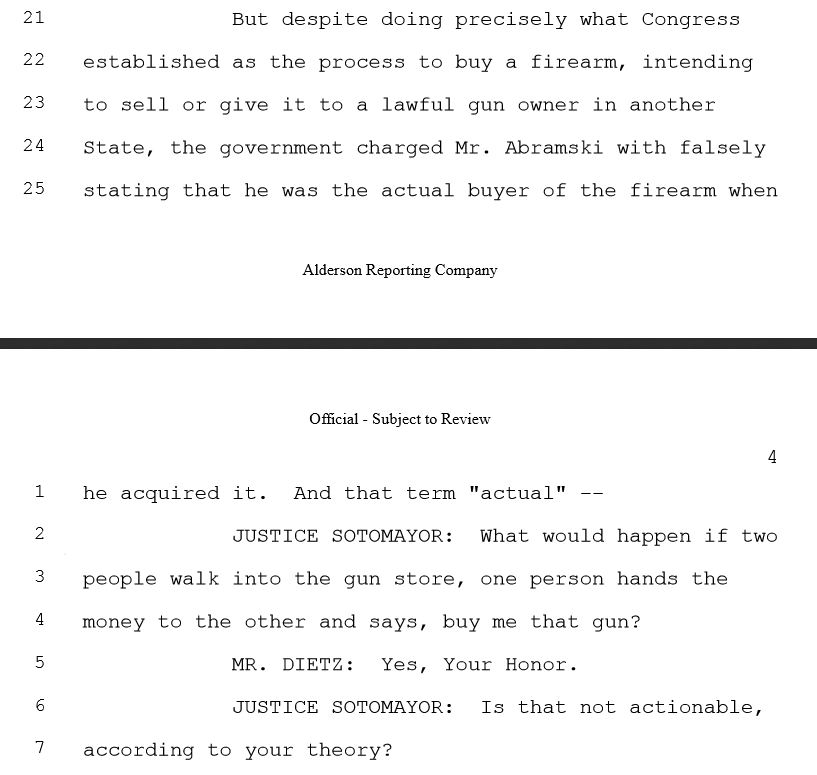
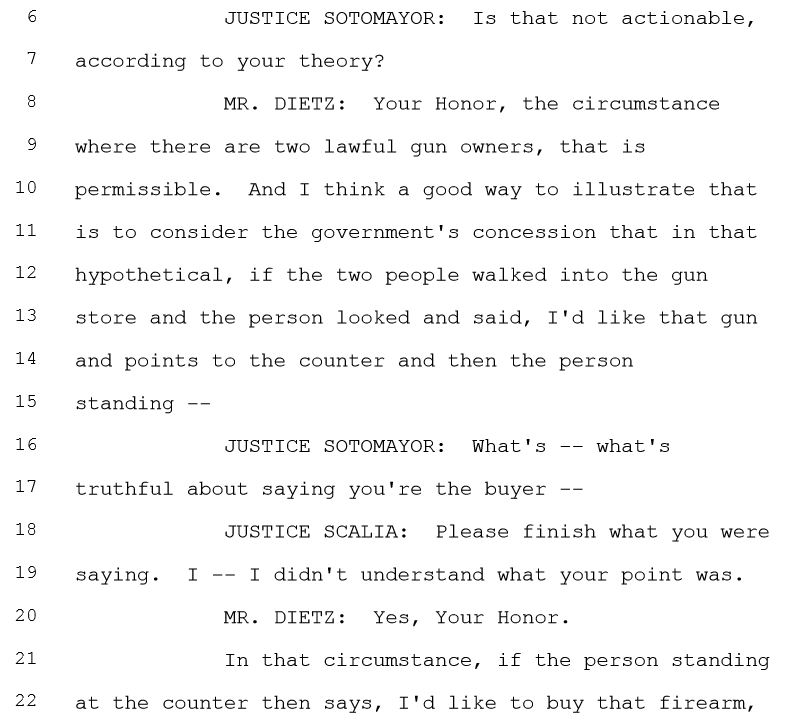
Attorney Richard Dietz, representing Abramski, was beginning his 6th sentence, 50 seconds into his opening, simply reviewing the facts of the case, when Justice Sonia Sotomayor jumped in to ask him a question. Abramski Transcript 1As Dietz was trying to answer the question, Sotomayor pressed her questioning, but then an interesting thing happened. A more sympathetic justice, Antonin Scalia, came to Dietz’s aid. Abramski Transcript 2

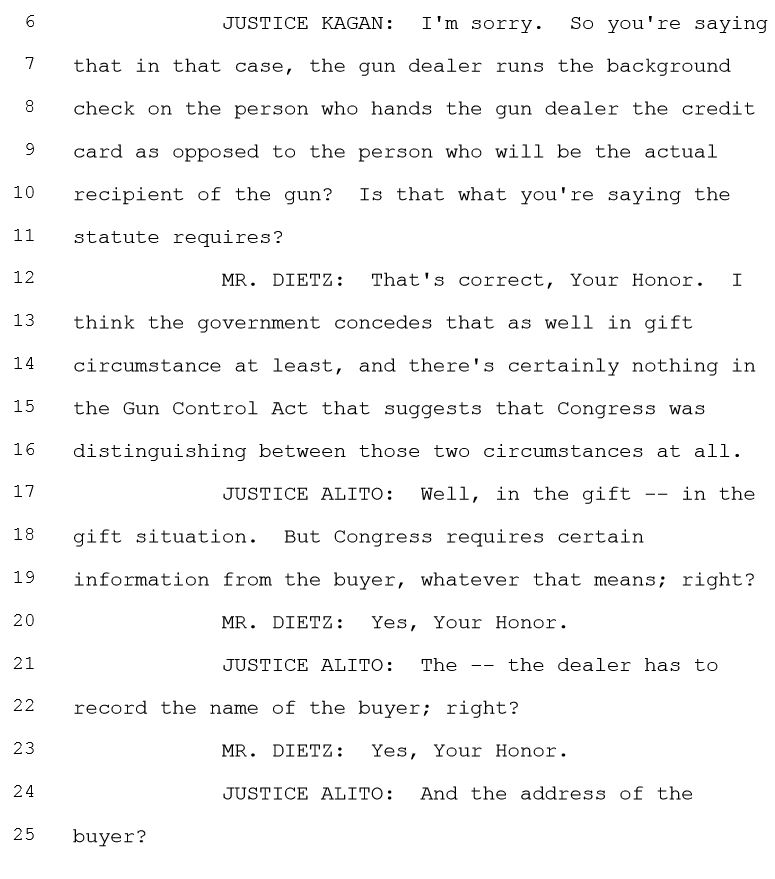
Dietz continued following Scalia’s save, only to draw more fire from Justice Elena Kagan and the immediately after, Justice Samuel Alito. Abramski Transcript 3And so on for 25 minutes. Despite getting 25 minutes to present his case, reserving 5 minutes for rebuttal, Dietz actually shared his time with 8 justices (all but Clarence Thomas). So, he has to continue to try to make his case while at the same time responding to persistent questioning from the justices.

A great challenge and why it is a rare honor and ability to argue cases before the Supreme Court. And why it should be a bucket list item for American citizens.

CONCLUDING ASIDE: In the talk I attended the speaker gave some interesting facts about decisions handed down in the last term (2013). Of approximately 70 cases, almost 40% were unanimous decisions by the 9 justices. Just under 30% were “split” decisions — either 6-3 or 5-4. This suggests that most of the cases decided by SCOTUS are not driven by an ideological “liberal” vs. “conservative” divide.


Official Catholic View of Use of Lethal Force in Self-Defense

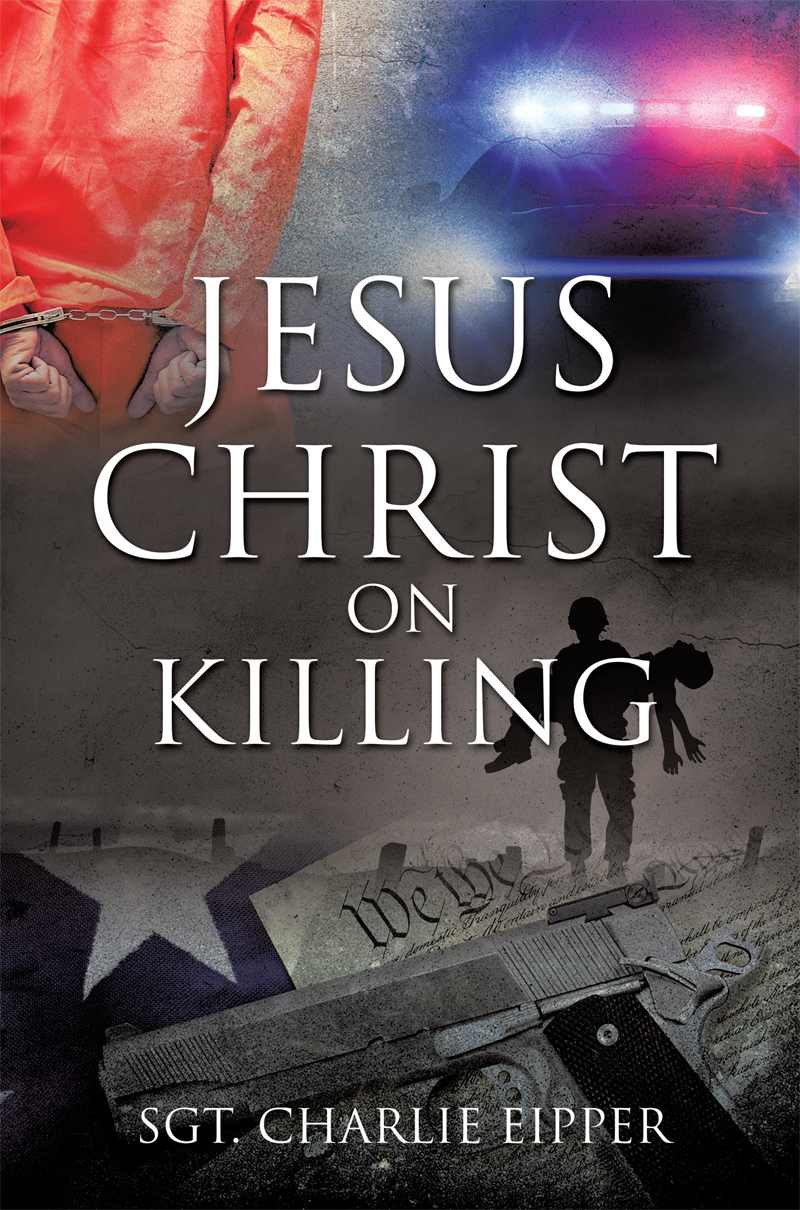
Miguel at the Gun Free Zone blog posted recently about a new book by a Texas police officer called Jesus Christ on Killing.

jesus-christ-on-killing-coverI expect to see evangelical Christians taking this position, but Miguel brings to light some interesting passages from the Catechism of the Catholic Church that I had not previously read:

The seldom discussed subject of the legitimate killing of a human being and how does that mixes with Judeo/Christian values.  As a Catholic (although in a long hiatus) I refer to the Catechism regarding the Fifth Commandment

2263 The legitimate defense of persons and societies is not an exception to the prohibition against the murder of the innocent that constitutes intentional killing. “The act of self-defense can have a double effect: the preservation of one’s own life; and the killing of the aggressor. . . . The one is intended, the other is not.”

2264 Love toward oneself remains a fundamental principle of morality. Therefore it is legitimate to insist on respect for one’s own right to life. Someone who defends his life is not guilty of murder even if he is forced to deal his aggressor a lethal blow:

 If a man in self-defense uses more than necessary violence, it will be unlawful: whereas if he repels force with moderation, his defense will be lawful. . . . Nor is it necessary for salvation that a man omit the act of moderate self-defense to avoid killing the other man, since one is bound to take more care of one’s own life than of another’s.

2265 Legitimate defense can be not only a right but a grave duty for one who is responsible for the lives of others. The defense of the common good requires that an unjust aggressor be rendered unable to cause harm. For this reason, those who legitimately hold authority also have the right to use arms to repel aggressors against the civil community entrusted to their responsibility.

A burden we do not seek but we know we might face.

Catechism of the Catholic Church


Jennifer Dawn Carlson on Gun Politics in America

As part of my ongoing effort to understand “Gun Culture 2.0,” I was fortunate recently to host a leading sociologist studying American gun culture, Jennifer Dawn Carlson.

Jennifer_Dawn_Carlson_Lecture_Flier_Feb_14

Dr. Carlson is an assistant professor at the University of Toronto, but despite working north of the border she is an American and primarily studies American society. She has published a number of newspaper opinion pieces which attempt to speak across the divide between “pro” and “anti” gun camps. Among these are: “The Gun Debate Misses the Mark in Detroit” in the Detroit News and “The NRA’s Hidden Power” in the Los Angeles Times.

Carlson’s presentation last month was based on ideas she is developing in a forthcoming book called Citizen-Protectors: The Everyday Politics of Guns in an Age of Decline (Oxford University Press, 2015). The book draws on research conducted on gun carriers — both open and concealed — in and around Detroit, Michigan, hence the “age of decline.” She argues that within the context of socioeconomic decline in general and personal decline experienced by men in particular, gun carriers reassert their relevance by identifying themselves as “citizen-protectors” (her term, not theirs).

In Carlson’s analysis, the social identity of the citizen-protector: (1) “Redefines lethal shooting, under certain circumstances, as a morally upstanding response to violent threat and an affirmation of one’s love for life,” (2) “Draws on the duty to protect as a historically male-dominated social function,” and (3) “Emphasizes protection as an esteemed form of masculinity.”

Thus, to understand why a growing number of Americans are getting licensed to carry handguns in public (or are exercising their right to open carry without a license where that is allowed) requires getting beyond the gun itself. Carrying a gun is about more than personal self-defense; it is an assertion of “relevance, dominance, and dignity.”

20140218_154411

One thing I find particularly valuable about Carlson’s work is her valiant effort both to understand where gun carriers are coming from and to explain this to those who come from outside the gun culture. Her ability to speak across the divide, I hope, is enhanced by the fact that she did all that she could (as a young female from the People’s Republic of Berkeley) to walk-the-walk with gun carriers. She got a Michigan concealed carry license and carried a firearm regularly, she became an NRA Certified Firearms Instructor, and she even open carried a handgun into a Detroit police station as part of a protest by open carriers. Short of actually shooting someone in defense of self or others, she did all she could to establish her bona fides.

Because I read it in draft form, I will not give away one of the punch lines to her book, but Carlson draws some important conclusions based on her time interviewing and hanging out with gun carriers. Conclusions she could only reach by hanging out with gun carriers. I am anxiously awaiting the publication of Citizen-Protectors to see whether those conclusions resonate with a broader audience.

Gun Digest Magazine Shows How NOT to Create a Pie Chart

Thumbing through the February 13, 2014 issue of Gun Digest magazine, I was excited to see data on a recent survey of first-time gun buyers, attributed to the National Shooting Sports Foundation (NSSF), the trade association for the shooting, hunting and firearms industry.

Two pie charts, shown below, describe (1) the percentage of new shooters who engage in certain activities (target shooting, hunting, plinking, etc.), and (2) how frequently new shooters shoot.

These are both very important pieces of information, but what’s wrong with this picture?

Gun Digest magazine, 13 February 2014, p. 11

If you answered that the pieces of the pie chart do not add up to a meaningful whole, you are correct. The first pie chart totals 264% and the second totals 80.3%. A meaningful whole in this case would be 100% of new shooters.

Pie charts are appropriate visual displays of information when we want to show the relative sizes or proportions of different phenomena as a part of a fixed whole. If one slice of the pie grows, another slice has to shrink. You can’t just expand the pie (to 264%). If you remove a slice of the pie, the other slices have to grow. You can’t just shrink the pie (to 80.3%).

A pie chart is not appropriate for a situation in which a single respondent can choose more than one category (a new shooter can be a target shooter and a hunter and a plinker, for example). Or when there are categories of responses that are not displayed (19.7% of new shooters shoot less than once a week or did not respond to this particular question, we can infer). In these cases, a bar chart is more appropriate to display the relative sizes of phenomena.

For a really excellent discussion of pie charts and their potential pitfalls, see “Understanding Pie Charts” on the eagereyes blog.

Reflections on My Reflections on Gun Culture Based on Site Statistics

Since November 2012, when I first started working in earnest on a new research project on American gun culture, I have tried to blog regularly at Gun Culture 2.0. I have been averaging about 5 posts a month since then, which is pretty good compared to my previous attempts at blogging (like on this blog).

As I noted in one of my first posts, “Jumping into the gun culture as a complete novice is like jumping into the deep end of the pool without knowing how to swim.” I wrote this after the movie theater attack in Aurora, Colorado that month. Things only got worse later in 2012 when the Sandy Hook massacre took place. What was already a challenge to get up to speed on only became worse.

As a consequence, my posts on Gun Culture 2.0 have ranged widely from my own experiences shooting to reviews of books about guns to my attempts to understand existing research on guns. I am pretty much all over the place.

I began the blog as a way to force myself to reflect in writing on gun culture – a way to force myself to write! – but not many people who take the time to write do it only for themselves. So of course I have been interested to know if anyone out in cyberspace is looking at my posts. Recently I decided to look at my site statistics to see how many people have visited and what they have been most interested in reading about.

Top Blog Posts

The majority of my posts have fewer than 100 views, so the 6,370 total page views since I started Gun Culture 2.0 are dominated by a few entries. The home page not surprisingly leads the way with 1,415 views (though June 14).

1. Massad Ayoob’s MAG-40 Course – A Humanitarian Approach to Armed Citizenship (735 views). This is a long entry, but for anyone interested in a very thoughtful approach to the rights and responsibilities of armed citizenship, Massad Ayoob is the man.

2. Understanding Case-Control Studies of Gun Ownership as a Risk Factor (656 views). I am glad so many people have looked at this, because a lot of the most often cited statistics on the dangers of keeping a gun in one’s home is based on case-control designs. I learned a lot myself about this methodology in writing this entry.

3. Massad Ayoob Checks the Accuracy of My Handgun (612 views). This entry is just funny, because you often hear people who shoot guns say things like, “That gun doesn’t shoot well.” Given my own experience, I wonder what percentage of the time the actual statement should be, “I don’t shoot well.” Guns don’t shoot badly; people shoot badly.

4. Assessing the Great Ammo Shortage of 2013 (592 views). The fact that this entry has gotten as many views as it has suggests how concerned people are about the ammo shortage.

5. Shooting the MAG-40 Qualification Course (545 views). Three of the top 5 most visited pages on my site have to do with Massad Ayoob and his MAG-40 course. Overall this suggests that people are a lot more interested in Massad Ayoob than they are in me!

6. Investigating the New York Times’ Dangerous Gun Myths (173 views). This entry is another long one, and probably too boring for mass consumption, but looking at specific claims made in a NYT editorial claiming to debunk gun myths is important for those who want to look below the surface of those claims.

7. The Culture of Fear and the Mass Murders of 2012 (114 views). Here is another entry I wish more people would read. Recently, a big to do was made about the near-simultaneous release of a government study that showed violent crimes committed with guns is way down over the past 20 years, and a Pew Research Center poll that shows that people perceive gun crime to be going up. But this is an old story — crime down, fear up – as I note in this entry from January 2013.

8. Thoughts on Banning Certain Types of Rifles and Magazines (107 views). Banning so-called “assault rifles” and so-called “high capacity” magazines is a panacea designed to make us feel better without making us significantly safer. Enough said, but I wish more people had looked at this page, too.

Visitors

From its inception, Gun Culture 2.0 has had 6,370 page views. I don’t have any basis for comparison in terms of blog readership, but I know this is more people than bought my first three books combined!

The best ever single day was 142 views. On that day I posted an entry on “Looking Forward to History’s Top Shot Season 5 All-Stars.” I like this because as I noted in my first ever entry, Top Shot had a major role in my interest in guns and gun culture.

My best month ever was May 2012 with 1,687 views. That was up from just over 1,000 in each of March and April. If I can get 1,000 page views a month, I am happy with that.

Although the vast majority (5,352 of 6,370) visits have been from the United States, I have also had 548 visitors from Australia, and the other 400+ visitors have come from 60 other countries including Vietnam, Slovenia, Kuwait, Nepal, South Africa, and Malta.

Ten Essential Observations on Guns in America by James D. Wright

In my introduction to sociology class this week, I am discussing sociologist James D. Wright’s classic essay, “Ten Essential Observations on Guns in America” (from Society March/April 1995, reprinted in Guns in America: A Reader).

Among his points: “There are 200 million guns already in circulation in the United States. . . . firearms are the most commonly owned piece of sporting equipment in the United States.” [Note: 270-300M today]

“Most of those 200 million guns are owned for socially innocuous sport and recreation purposes. . . . Gun ownership is … more appropriate to the sociology of leisure than to the criminology or epidemiology of violence.”

“Many guns are also owned for self-defense against crime, and some are indeed used for that purpose; whether they are actually any safer or not, many people certainly seem to feel safer when they have a gun.”

“Most of the gun violence problem results from the wrong kinds of people carrying guns at the wrong time and place.” Or as Canadian journalist Daniel Gardner says in The Science of Fear, “if you are not a drug dealer or the friend of a drug dealer, and you don’t hang out in places patronized by drug dealers and their friends, your chance of being murdered with a handgun shrinks almost to invisibility.” Or as Gun trainer John Farnham says: “Don’t go stupid places or do stupid things with stupid people.” This lowers your risk of homicide substantially, whether you have a gun or not.

“Everything the bad guys do with their guns is already against the law.” To wit: Sandy Hook shooter shot his mother (murder), illegally transported firearms into a gun free zone, etc. (some say he violated as many as 40 laws).

The first law of economics: “Demand creates its own supply.” Outlawing alcohol didn’t work, making certain drugs illegal hasn’t kept them out of the United States. If cocaine can make it from Colombia to Chicago, who thinks guns won’t make it from Brazil to Chicago?

“Guns are neither inherently good nor inherently evil; guns, that is, to not possess teleology.”

“Guns are important elements of our history and culture. . . .restrictions on the right to ‘keep and bear arms’ amount to the systematic destruction of a valued way of life and are thus a form of cultural genocide.”