What I’m Reading: Grant Achatz’s “Life, On the Line”

I had heard of but did not know anything specific about Grant Achatz and his Chicago restaurant Alinea prior “reading” (i.e., listening to) Life, On the Line: A Chef’s Story of Chasing Greatness, Facing Death, and Redefining the Way We Eat.
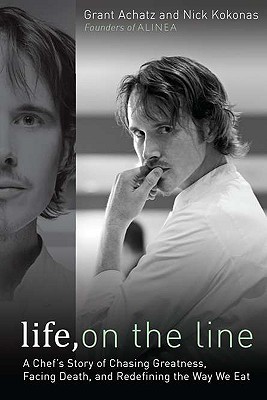
The book is cleverly and accurately titled, as it tells the story of Achatz’s career as a chef working “on the line” in various kitchens (including for such luminaries as Charlie Trotter and Thomas Keller) and it also tells the story of Achatz’s diagnosis of and battle with the cancer that put his life “on the line.” Cruelly ironic was that he develped stage IV squamous cell carcinoma-tongue cancer at the same time that he was being recognized as one of the best chefs in America.

I didn’t realize until I reached his chapter that the book was co-authored with Achatz’s friend and business partner Nick Kokonas. At first I thought, why do I care what the financier has to say? I want to know about the chef and his cooking. But then I realized having Kokonas as a co-author and alternating chapters between Achatz and Kokonas was very clever because it allowed Kokonas to say all of the very flattering things about Achatz that it would have been uncouth for Achatz to say about himself. And given his ability as a chef, those flattering things are a very important part of the story.

Why are my students so DOUR?

Dour. If I had to use one word to describe my students, that would be it. Maybe I’ve already blogged about this. I can’t remember. But it bears repeating.

On more than one occasion, I have looked out at a room full of students and yelled, “Why are you so DOUR? You have EVERYTHING!”

I met women selling bags of water on the streets of Accra, Ghana who were happier than these students. Students who watch TV on plasma screens in their dorm rooms, then drive their BMWs to eat sushi for dinner, before getting a couple of hours of studying in between IMing, BBMing, texting, and Facebooking their friends. OK, so that’s an exaggeration. Sort of.

I thought of these dour students recently when I was listening to an old interview with David Foster Wallace on “Fresh Air,” the NPR show. Wallace has recently committed suicide at age 46. I haven’t read his fiction, most notably his novel “Infinite Jest,” but his essay on “Roger Federer as a Religious Experience” in the New York Times magazine a couple of years ago was amazing.

In any event, in the interview with Terry Gross, he talks about the inspiration for his novel “Infinite Jest” being his realization at age 30 that despite having been grotesquely privileged their whole lives he and his friends were also extraordinarily sad. He attributes this in part to the fact that “success” in our culture means: make alot of money, have an attractive spouse, and become (in)famous in some way — i.e., experience as much pleasure as possible, which ultimately is empty.

Viewed through this lens, binge drinking and random hooking up (for example) is a symptom, then, not a cause of a generation of college students who are privileged, sad, hollow, and dour.

Correct me if I’m wrong.

No reading, bad writing

Everyone I know who is a good writer is also a good reader. A recent article in the Chronicle of Higher Education, then, helps to explain why so many of the students I teach are (to put it bluntly) bad writers.

The article reports on a study released by the National Endowment for the Arts called “To Read or Not to Read: A Question of National Consequence.”

Among the findings: in 2006, 15- to 24-year olds in America spent just seven minutes on voluntary reading (including online reading) per day during the week and 10 minutes a day on weekends. On the other hand, they spend 2-2.5 hours a day watching television.

There it is.

Spare Prose PLEASE!!!

Somewhere along the way, probably in high school, college students learn that “good” writing means long sentences and big words. But in my experience, most students don’t have the linguistic dexterity to pull this off. It just becomes an overwrought jumble of words and punctuation.

Not that I can do much better myself, but I do try to take the advice of William Zinsser in On Writing Well to cut everything I write IN HALF.

I was reminded of the strength of spare prose in a review of Run by Ann Patchett in the September 30th issue of the New York Times Book Review. Reviewer Leah Hager Cohen writes, “Among the many things to admire about Ann Patchett is the lack of frivolity in her prose. She prefers nouns and verbs to crowded flights of lyrical adjectives and adverbs, and she doesn’t dally excessively over a pretty phrase. Patchett is more hammer and nails than glue and lace; small wonder, then, that her books tend to be such solid, weight-bearing constructions.”

Girls Gone Wild. . . What’s the attraction for women?

I think we can understand the attraction of “Girls Gone Wild” to men. Men, after all, are pigs. But what’s the attraction for the women (or, rather, “girls”)? Is this sort of soft-core porn exhibitionism empowering for these women? Or is it just more of the same?

Listen to the author of Female Chauvinist Pigs: Women and the Rise of Raunch Culture, Ariel Levy, on “Fresh Air” with Terry Gross from Tuesday, November 28th.

Books are Good

“A personal library is an X-ray of the owner’s soul. It offers keys to a particular temperament, an intellectual disposition, a way of being in the world. Even how the books are arranged on the shelves deserves notice, even reflection. There is probably no such thing as complete chaos in such arrangements.”

-Jay Parini, “Other People’s Books”
The Chronicle of Higher Education
22 September 2006

I’m Back!

I guess I took the summer off. I didn’t mean to, but teaching summer school wiped out 8 weeks, then I had 4 weeks to do 12 weeks worth of other work. A couple of brief points by way of getting back into things:

1. I (heart) Montreal. Spent a week up there with my boy, Shattuck Slim, at a conference and LOVED it. I also developed a fondness for The Netherlands while there. What I learned: in French, a bow tie is called “noeud papillon” — knotted butterfly. Beautiful. Thanks to Nadia at Harry Rosen for that.

2. I (heart) Ana Ivanovic, who won the Coupe Rogers in Montreal the week after I was there.

3. Now that classes have started again this fall, I have to ask: why do so many students refer to any book as a “novel”?

To the Class of 2006

On the occasion of graduation, an excerpt from Alan Lightman’s novel, Reunion (in which the narrator attends his 30th college graduation reunion):

“Young people explode with their discovery of the world and the newness of life. They sleep and sleep in their tiny cocoons, and suddenly one day, perhaps in one moment, as in the moment Juliana first kissed me, suddenly a young person wakes up and finds the universe tilting and gasping in front of him. Infinity. So many things are happening for the first time. What young people don’t realize is that so much is happening for the last time as well. The world is both opening and closing at once.

The first kiss, the first ecstasy of love, the play of light in the trees on a particular fall day, the endless flood of strength in our biceps and thighs. We have the illusion that all of this will happen again and again. In a way this falseness of youth is even more painful than the branching channels ahead. For the young are very much aware of the moment of the first kiss, the first ecstasy of love, and so on. They are keenly aware. Their terrible miscalculation is thinking that these moments will repeat in the infinity of time, that their bodies and minds will hold.”

Enjoy the rest of your lives, Graduates of the Class of 2006!

Student (Dis)Engagement?

From “A Very Long Disengagement” by Mark Bauerlein, Chronicle of Higher Education (6 January 2006):

“Last spring Nielsen Media Research reported that the average college student watches 3 hours 41 minutes of television each day. . . . Last year the National Survey of Student Engagement found that 44 percent of first-year students never discuss ideas from their readings or classes with their professors outside of class. . . . The trends are not unrelated. The more young people gather to watch TV shows, transmit e-mail and text messages, and blog and chat and surf and download, the less they attend to their regular studies. . . .

To repeat, the more time young adults devote to activities like sending e-mail messages, the less time they devote to books, the arts, politics, and their studies. Time has proved the formula. In the 1990s the gurus and cheerleaders of technology promised that the horizon of users would expand to take in a global village, and that a digital era would herald a more active, engaged, and knowledgeable citizenry, with young adults leading the way. It hasn’t happened. Instead, youth discourse has intensified, its grip on adolescence becoming even tighter, and the walls between young adults and larger realities have grown higher and thicker.”

Classroom Dynamics

“Any questions?” asked Howard.
The answer to this never changed. Silence. But it was an interesting breed of silence particular to upscale liberal arts colleges. It was not silent because nobody had anything to say — quite the opposite. You could feel it, Howard could feel it, millions of things to say brewing in this room, so strong sometimes that they seemed to shoot from the students telepathically and bounce off the furniture. Kids looked down at the table top, out of the window, or at Howard with great longing; some of the weaker ones blushed and pretended to take notes. But not one of them would speak. They had an intense fear of their peers. And, more than that, of Howard imself.

–from Zadie Smith, On Beauty (2005)